Zum Inhalt springen

Biographies

The biographies commemorate people who were interned at the Gunskirchen satellite camp. The focus is on the victims and survivors, their experiences, memories, and life stories.

For selected biographies, visitors can listen to personal accounts narrated by well-known figures, giving voice to the memories of contemporary witnesses.

This section is being continuously expanded. In the future, additional biographies of victims, survivors, liberators, perpetrators, and other individuals whose life stories and accounts contribute to our understanding of the history of the Gunskirchen satellite camp will be added.

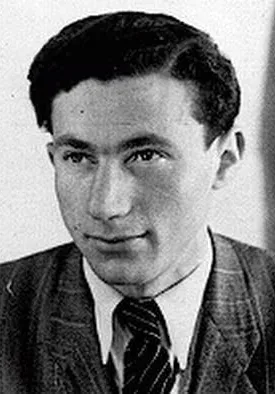
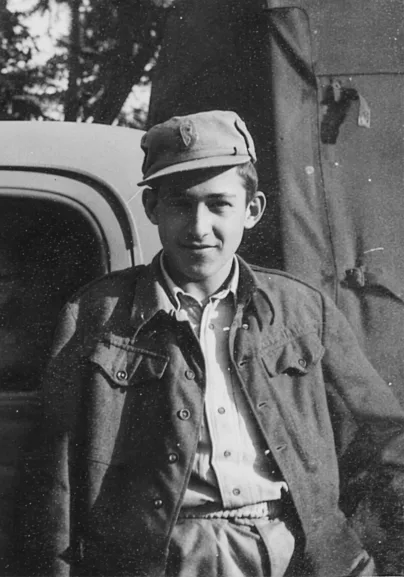
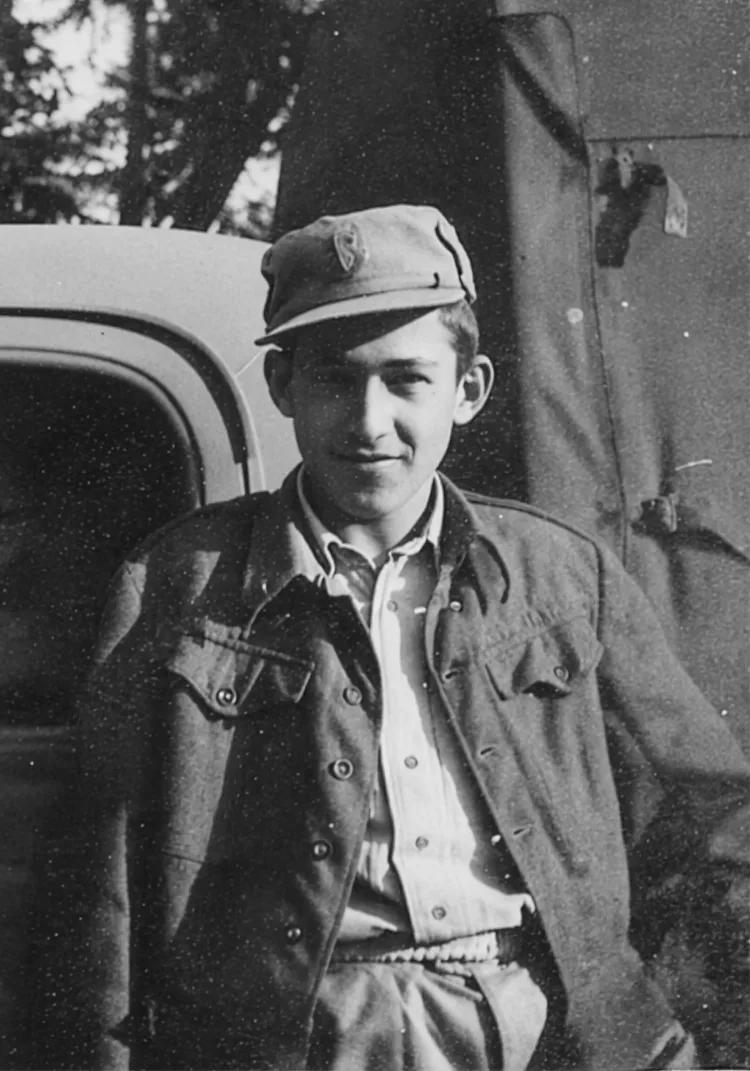
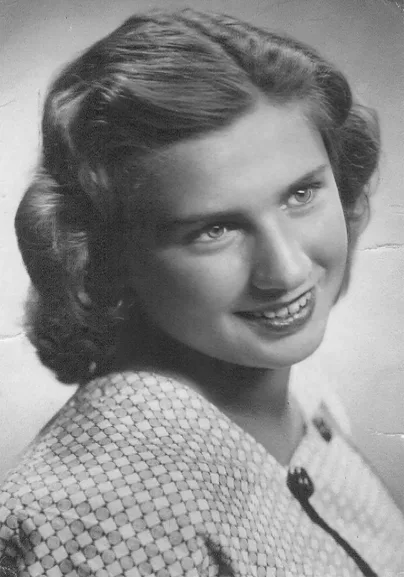
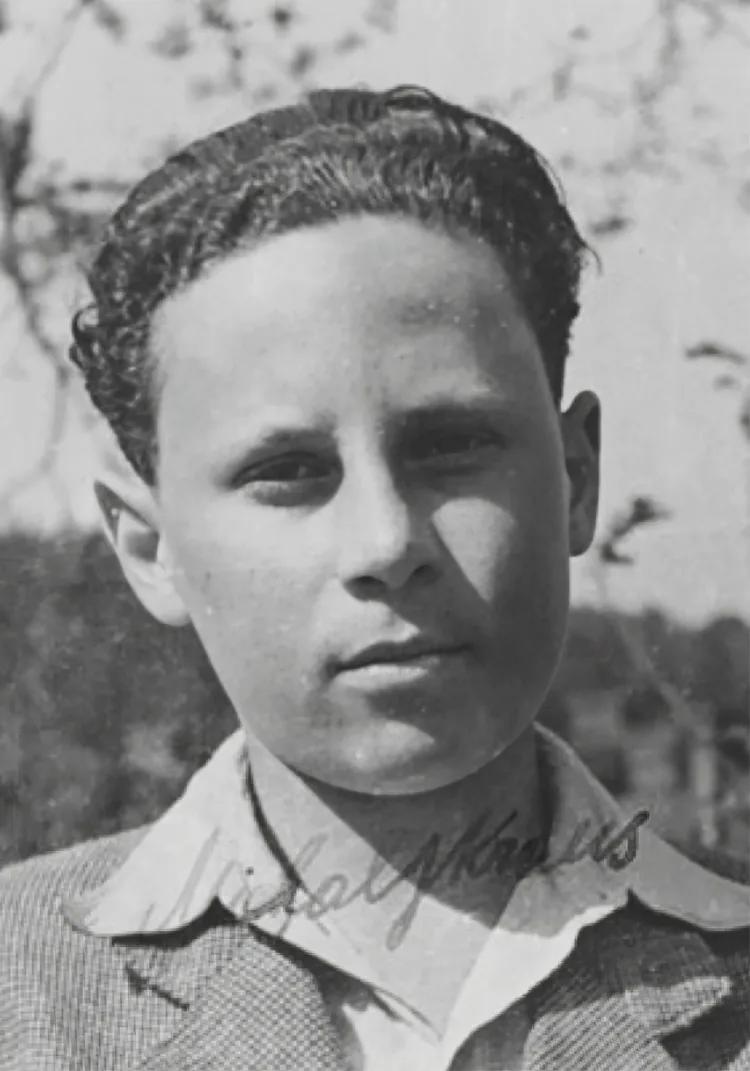
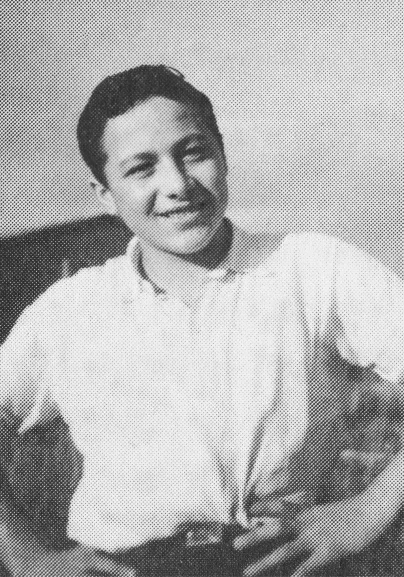
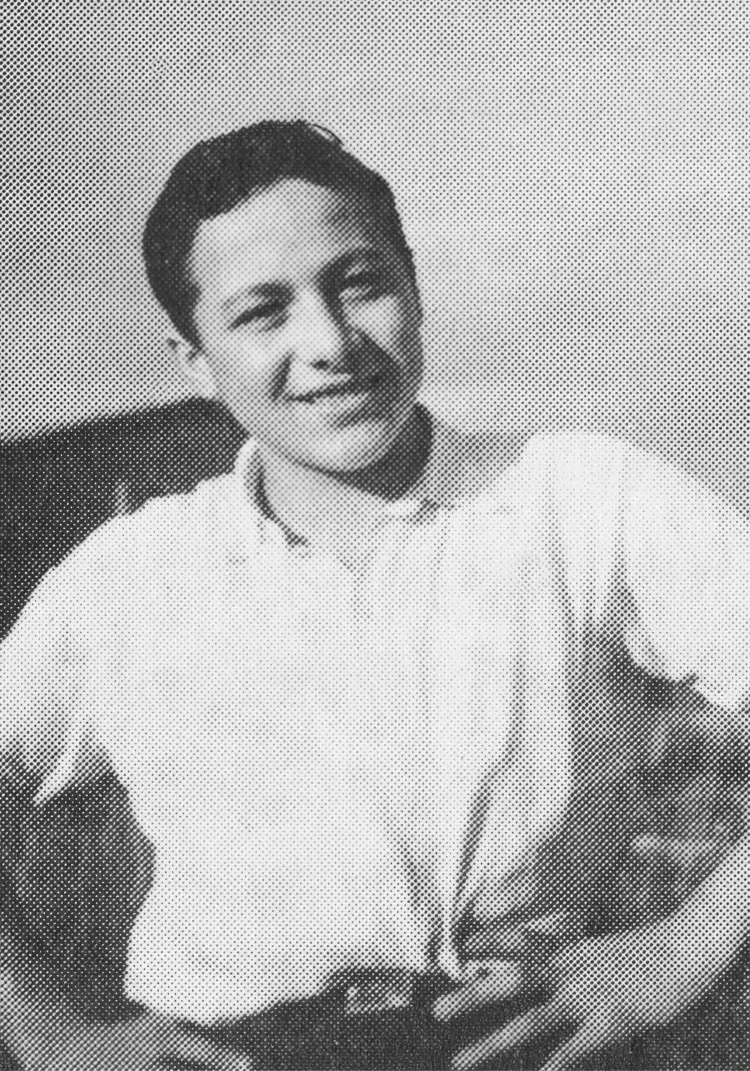
  1. Wolfgang Sinai Adler Wolfgang Sinai Adler
    Wolfgang Sinai Adler

    Wolfgang Sinai Adler was born into an Orthodox Jewish rabbi’s family in Prague on 11 July 1928. His father, Dr Šimon Adler, came from Dobrá Voda in the Bohemian Forest. He was a Jewish scholar, rabbi, historian and the director of the archives of Prague’s Jewish community. Wolfgang’s mother Reisel was the daughter of Rabbi Sinai Schiffer, a Jewish scholar from Karlsruhe. Wolfgang was the youngest of three brothers and attended both Jewish and Czech schools. His family mainly spoke German at home. Wolfgang’s second eldest brother died in 1937.

    When the Nazis invaded and occupied Czechoslovakia in March 1939, Wolfgang’s life changed dramatically. From then on, Jews had to wear the yellow Star of David. Jewish children were no longer allowed to go to school and there were signs everywhere reading ‘Für Juden verboten’ (‘No Jews allowed’). The Adler family wanted to emigrate, but only Wolfgang’s eldest brother, the young Matisyahu, managed to leave the country and travel to what was then Palestine.

    On 6 March 1943, the then 14-year-old Wolfgang was moved to the Theresienstadt ghetto with his parents. Wolfgang worked in a bakery in the ghetto and this meant that he was able to get bread for his sick parents. On 18 May 1944, the Adler family was deported to Auschwitz-Birkenau extermination camp in a cattle car with 2000 other residents of the ghetto. On his arrival there, Wolfgang had the number A1450 tattooed on his left forearm.

    The Adlers were committed to the ‘Czech family camp’, which served the Nazi propaganda machine as it enabled them to pretend to the world that Jews were being treated well. But in July 1944 it was closed and Wolfgang’s parents were killed. Wolfgang was selected by Mengele with 89 other Czech boys and forced to carry out cleaning work in the SS barracks and work as an errand boy for the SS. Later, he was moved to the Pławy satellite camp, an SS supply camp, and ordered to look after the horses.

    With the Soviet army’s advance and the start of the death marches in Auschwitz-Birkenau, the SS supply camp was also evacuated and everything was loaded onto horse-drawn carts. Wolfgang had to walk while the SS officers rode on the carts. Bodies of prisoners who had been shot or frozen to death lay by the side of the road. There were was nothing to eat for days. Finally, the SS locked the prisoners into cattle cars bound for Mauthausen concentration camp, where they arrived on 23 February 1945 after a three-week odyssey.

    While they were being admitted to the camp, Alois Holub, a Czech prisoner, spotted Wolfgang, who was at that point completely dehydrated. The 27-year-old Holub had been imprisoned in the concentration camp since 1941 because of his Communist activities. But his training as a cabinetmaker meant that he enjoyed preferential treatment in the camp and carried out inlay work for the SS officers. He regularly smuggled extra soup and bread to the Jewish boy. This saved Wolfgang’s life and he, in turn, shared the food with other Czech boys. When Wolfgang was moved to the tent camp in early April 1945, Holub secretly gave him a woollen sweater with paper and a pencil wrapped inside it and whispered to him: “Write to me when you need something!”

    When Wolfgang was suffering with severe diarrhoea and a high fever in the tent camp, he managed to successfully smuggle five secret messages out of the tent camp. He asked Holub for a spoon, bread, soup, salt and even charcoal tablets. Without these supplies he would not have survived the tent camp in Mauthausen – or the subsequent death march to the Gunskirchen satellite camp and the appalling conditions there, which he later described as the worst time of his life.

    After the liberation on 5 May, Wolfgang left the camp with Jehuda Bacon. They were picked up by the American soldier Stanley Leeper on the road to Lambach and taken to the hospital in Steyr. After their recovery, they returned to Prague and were looked after at Štiřín Chateau by the teacher Přemysl Pitter. When they spoke on the telephone, Holub, who had also returned to his home country, offered to care for Wolfgang as if he was his own son. But Wolfgang wanted to join his brother in Palestine. After the Communist Party took control of Czechoslovakia, Wolfgang and Holub lost touch.

    In his new homeland of Israel, Wolfgang changed his name to Sinai Adler. He studied at a prestigious yeshiva [Jewish higher educational institution for studying the Torah] and became a highly respected scholar and rabbi. He served as the Chief Rabbi of the city of Aschdod for 20 years. But he never forgot what Alois Holub had done for him. When the Iron Curtain fell, he got in touch with Holub. Holub had kept Wolfgang’s messages from the tent camp all those years and now he gave them back to him. Alois Holub was honoured by the Holocaust memorial institution Yad Vashem in 1994 as ‘Righteous Among the Nations’ at the initiative of Sinai Adler and Jehuda Bacon.

    Rabbi Sinai Adler spent the final decades of his life in Mevasseret Zion near Jerusalem and died on his 92nd birthday on 11 July 2020 surrounded by his family.

    Source

    • Sinai Adler, Your Rod and Your Staff. A Young Man’s Chronicle of Survival. Jerusalem 1996; AMM OH/ZP1/703, interview by Kobi Kabalek with Sinai (Wolfgang) Adler, Mevasseret Zion 2002.
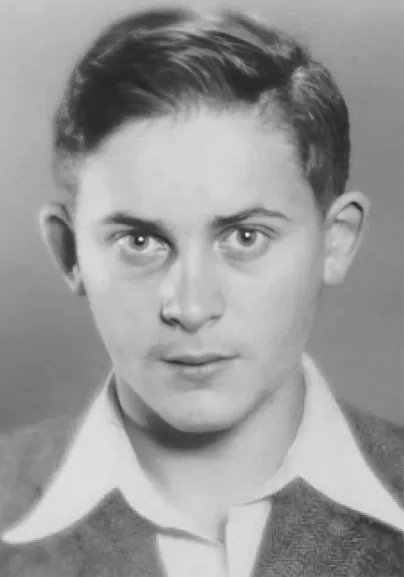
  2. Jehuda Bacon Jehuda Bacon
    Jehuda Bacon

    Jehuda Bacon was born in Ostrava in the former Czechoslovakia on 28 July 1929 as the youngest child of an assimilated Jewish family. His father, Israel Bacon, owned a leather factory. When the Germans occupied Bohemia and Moravia in 1939, the rights of the Jewish population were systematically restricted. As a result, Jehuda was no longer able to go to school or attend any other events.

    In 1942, Rifka, the younger of Jehuda’s sisters, managed to flee to what was then Palestine. The rest of the family were moved to the Theresienstadt ghetto in September of the same year. Even then, Jehuda was a talented artist, so was given the task of painting the SS signs in the ghetto. In December 1943 he was deported with his family to Auschwitz-Birkenau. Jehuda was assigned to the ‘children’s block’ of the Czech ‘family camp’, which was supervised by Fredy Hirsch. As a Jewish Kapo (prisoner functionary) Hirsch used his connections and the trust placed in him by the Nazis to continue in Auschwitz what he had previously started in Theresienstadt: the education and care of hundreds of children. Jehuda was allowed to paint the walls of the children’s block with fairy tale characters. Fredy Hirsch attempted to conceal from the children the fact that Jews were being murdered in the extermination camp’s gas chambers every day.

    The family camp was closed in July 1944. Jehuda’s mother and his sister Hannah were deported to Stutthof concentration camp, where they died of typhoid fever just a few days before the liberation. His father was killed in a gas chamber in Birkenau because he was 52 years old. But Jehuda was selected by Josef Mengele together with 89 Czech boys aged between 13 and 16 to carry out forced labour in Birkenau extermination camp. In the ‘cart forced labour detail’, he was harnessed to a cart with 20 other boys in place of a horse. It was their job to transport firewood to the crematoria and the ashes of the murdered prisoners to the disposal site.

    On 18 January 1945, he was driven on a death march from Auschwitz-Birkenau, which was being evacuated, together with thousands of Jewish prisoners. This march on foot in icy temperatures took Jehuda first to the Blechhammer satellite camp. There the prisoners, including many young people, were loaded into open goods carriages and transported to Mauthausen concentration camp, where they arrived on 30 January 1945 after a journey lasting several days with no food or water. Jehuda was given prisoner number 123585. The close bond between the Czech boys was the only thing that helped him survive.

    In early April, he was committed to the tent camp, where he witnessed terrible crimes, before being forced on another three-day death march to the Gunskirchen satellite camp. There he experienced terrible hunger and was also plagued by lice.

    When the camp was liberated by American troops on 5 May 1945, Jehuda walked out of the ‘Forest of the Dead’ with his friend Wolfgang Adler. A military jeep stopped next to them on the road to Lambach and the American soldier Stanley Leeper took the two boys, who were seriously ill with typhus and typhoid fever, to the hospital in Steyr. They were looked after there by the Catholic nuns for eight weeks.

    After their recovery, the two boys returned to their homeland of Czechoslovakia in the hope of finding surviving family members. Along the way, Jehuda bought himself a sketchpad and began to draw his experiences. Once they arrived in Prague, they learned that they were the only ones of their families to survive the Shoah. They found refuge in the Štiřín children’s home in the care of the Czech humanist and teacher Přemysl Pitter. Jehuda began drawing his traumatic memories of the Shoah and it was then that his extraordinary talent was discovered. His immigration to Palestine in 1946 was supported by various prominent figures from the world of art, enabling him to study art and design at Bezalel Academy of Arts and Design in Jerusalem.

    After studying in London and Paris, he went on to teach at Bezalel Academy himself from 1959 onwards and was later appointed professor of graphic art and drawing. The drawings he produced immediately after the war were of such high documentary value that they were used as evidence in the Eichmann trial (1961 in Jerusalem) and at the Frankfurt Auschwitz trials (1963–1965), where Jehuda also testified as a witness.

    Source

    • Michael Koller and Jürgen Lenssen [ed.], Jehuda Bacon, Malerei und Grafik [Jehuda Bacon, painting and graphics], Würzburg 2015; Angelika Schlackl, ‘Würde ich hassen, hätte Hitler gesiegt.’ Die tiefe Menschlichkeit des jüdischen Künstlers Jehuda Bacon. [‘If I were to hate, Hitler would have won’. The profound humanity of the Jewish artist Jehuda Bacon.] Brochure to accompany the theatre project of the same name and the ‘Jehuda Bacon’ exhibition. Linz 2019; Kurt and Angelika Schlackl, video interview with Jehuda Bacon, Jerusalem 2015.
  3. Pal Bacs Pal Bacs
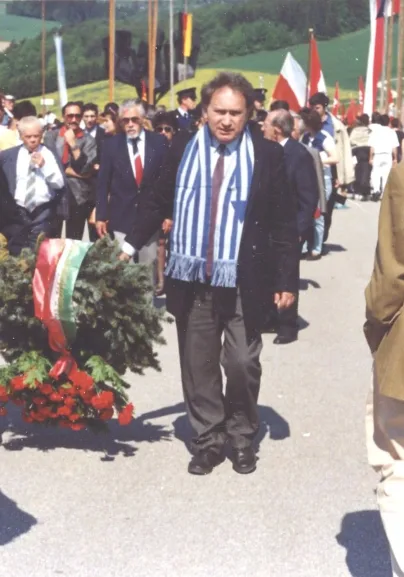
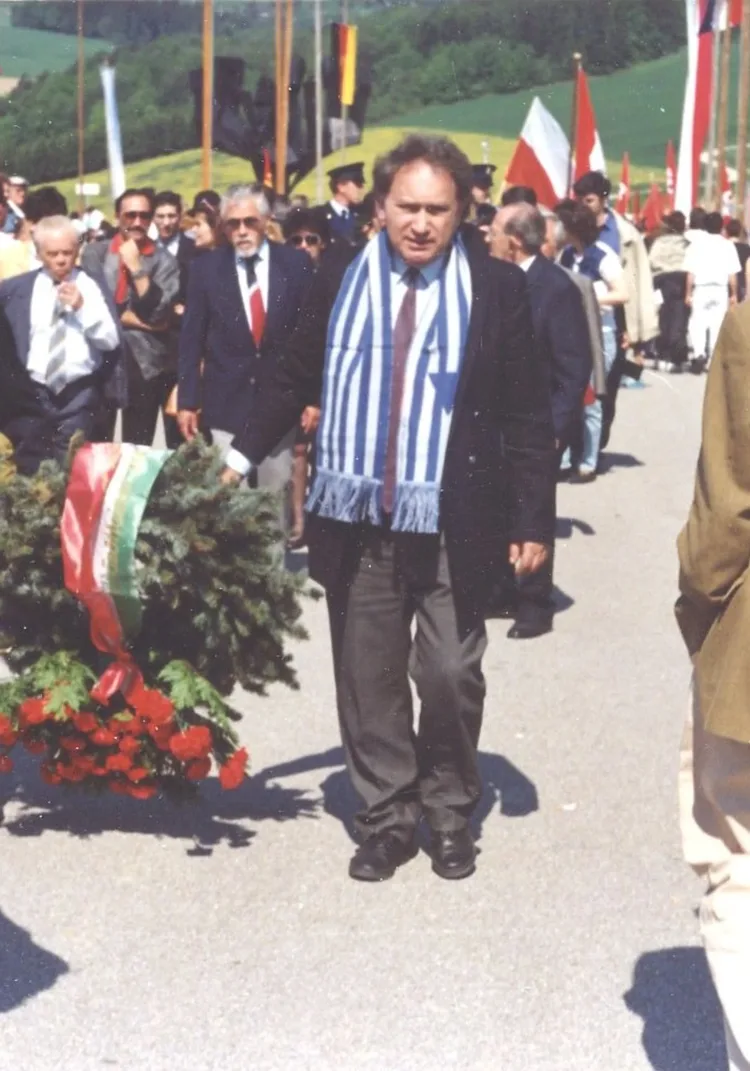
    Pal Bacs (mittig hinter dem Kranz mit schwarz-weißer-roter Krawatte) bei der Befreiungsfeier in der KZ-Gedenkstätte Mauthausen, 1985
    Pal Bacs (mittig hinter dem Kranz mit schwarz-weiß-roter Krawatte) bei der Befreiungsfeier in der KZ-Gedenkstätte Mauthausen, 1985 · © Mauthausen Komitee Österreich

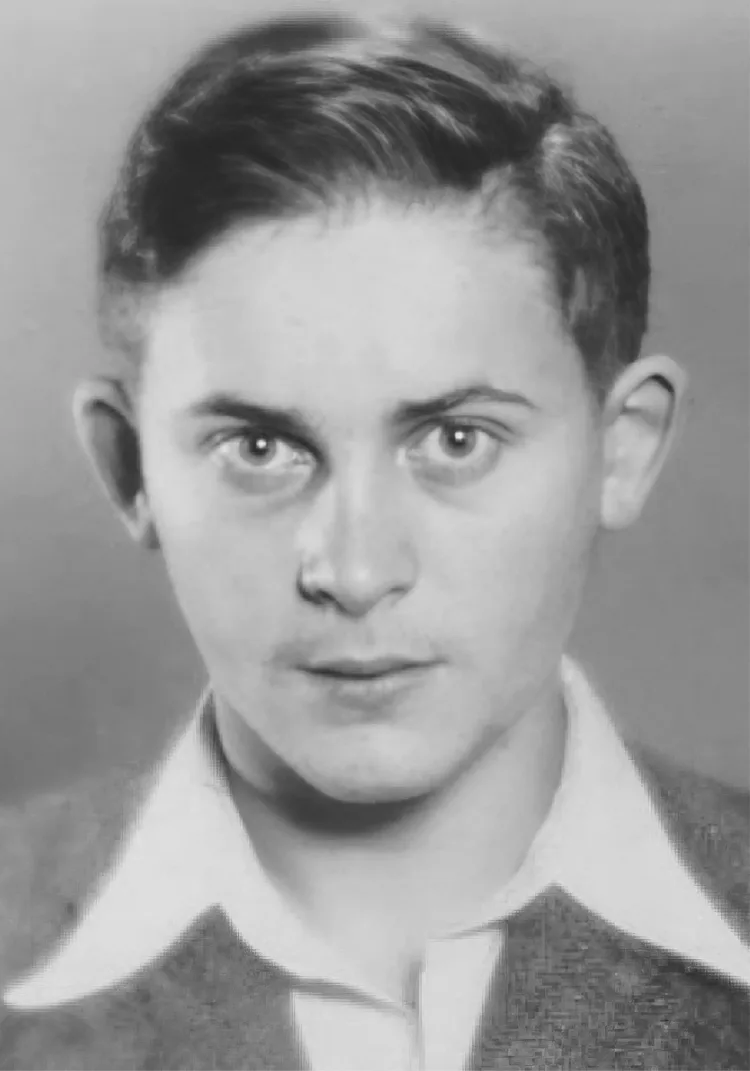
    Pal Bacs was born in Hungary in 11 September 1928 and grew up in a large family. In addition to his father Jenő and his older brother Tamás, his family also consisted of his uncle Geza, his aunt Gizi and his cousin Ági.

    Pal and his brother attended Werbőczy Grammar School, a highly regarded elite school in Budapest. The Jewish Pathfinder Movement was also an important part of his youth and gave him an opportunity to experience community, discipline and physical activity at a young age.

    German troops occupied Hungary on 19 March 1944. Pal was away on a trip in the area around Budapest on the day it happened. The persecution of the Jewish population became increasingly worse with the German occupation. From 1 September 1944, Pal had to start wearing the yellow Star of David on his clothes. The family also had to surrender their only radio so they couldn’t receive any messages.

    Before long, Pal was stopped from attending school and had to report to a construction site on Hunyadi-János Street instead. In the summer of 1944 Pal, who was then 15 years old, was working at an arms factory. There he helped to construct the bombproof tunnels that were dug beneath Buda Castle Hill.

    On 20 October 1944, a police officer appeared at the family’s door early in the morning and informed the Bacs family that they had just 15 minutes to pack their belongings. Pal and his brother Tamás had to go with him. At this point in time, Tamás was already sick. Although Pal had an ID card confirming his status as a worker in an arms factory, which would have potentially exempted him from deportation, he deliberately chose not to show it. He didn’t want to leave his sick brother by himself.

    The two brothers were transported first to Ferihegy and then to Pestszentimre. There they had to carry out forced labour in extremely difficult conditions.

    On 3 November 1944, Pal and Tamás managed to escape for the first time. They went to Budapest and were able to go back to their mother. But the very next day, on 4 November, the two brothers were arrested again and forced to march on foot for several days towards the Austrian border. But Pal and his brother managed to escape again. They flagged down a lorry and the driver agreed to take them with him. At a checkpoint, they were able to use their registration documents to identify themselves and were not recognised as Jews. When they reached Budapest, they found their father in a Jewish work detail on Bocskai Street. Their father arranged for his two sons to also join this work detail.

    But this security did not last for long. On 29 November 1944, Pal, Tamás and their father were again ordered on another forced march. At the Józsefváros railway station, they were crammed into cattle wagons and deported. Eventually, they arrived in Bucsu in western Hungary, where they had to perform forced labour.

    Some time later, Pal, his brother and his father were deported to Mauthausen concentration camp. At the end of April 1945, the prisoners of Mauthausen were forced to march to Gunskirchen. Pal, his brother Tamás, his father and his uncle Geza attempted to get through the march together. After several days of walking, they arrived at Gunskirchen on 24 April 1945.

    The camp was liberated on 5 May 1945. However, the liberation did not spell the end of Pal’s suffering. His brother Tamás and his father were seriously ill. The death of his father was particularly tragic with Pal the only family member with him in his final moments.

    After the liberation, Pal was initially treated in a field hospital. He eventually returned to Budapest on 8 July 1945. Once there, he discovered that his mother had survived. His uncle Geza, who had worked as a Kapo (prisoner functionary) in Mauthausen concentration camp, had also survived.

    After Pal had spent a longer period in hospital being treated for pneumonia, he continued his education. In just one year, he completed the 7th and 8th grades at the grammar school and successfully gained his school leaving certificate in 1946. After that, he studied medicine, gaining his degree in 1952. He then served in the Hungarian People’s Army for three years as a career officer and doctor. From 1955 onwards, he worked in the department for trauma surgery at the hospital on Péterfy-Sándor Street in Budapest.

    Alongside his work as a doctor, Pal Bacs was also heavily involved in remembrance activities for the victims of the Nazi regime. He was a member of the Comité International de Mauthausen (International Mauthausen Committee – CIM) and regularly attended the annual commemoration ceremonies. He visited concentration camps on research trips and collected information about the pseudo-medical experiments carried out there. He also worked as a medical expert for compensation cases.

    Pal Bacs was married and had one daughter and two grandchildren. He died in Budapest on 18 September 1995 at the age of 67.

  4. Yitzhak ‘Irving’ Balsam Yitzhak ‘Irving’ Balsam
    Yitzhak „Irving“ Balsam
    © United States Holocaust Memorial Museum

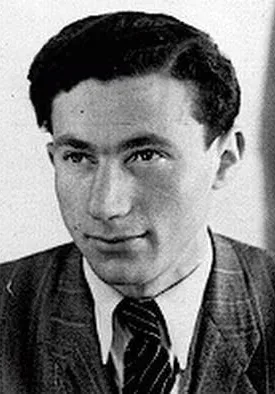
    Yitzhak ‘Irving’ Balsam was born in Praszka (present-day Poland) on 17 October 1924. His father worked as a tailor. His work was not steady, and the family struggled to make ends meet. Yitzhak attended Polish state school in the mornings and Hebrew school in the afternoons.

    On 1 September 1939, Yitzhak saw German soldiers marching into his hometown. For the next seven days, German convoys rolled through Praszka. Every day, Yitzhak and other Jewish men were forced to build roads outside town.

    Just a few months later, he was deported to the Auschwitz concentration camp and extermination camp. During the death marches, he attempted to escape near Gliwice but was later found and imprisoned with 60 other men. Most were executed and the rest were forced to transport the bodies to a cemetery where two mass graves had been dug. They buried the bodies in one, then were forced into the other and hit with machine-gun fire. When the shooting stopped, five of them were still alive. They were ordered to fill in the second grave, then the guns were turned on them again. Miraculously, they had run out of bullets.

    Yitzhak was sent to Mauthausen concentration camp for forced labour, and then to the Gunskirchen satellite camp to die. He was liberated by American soldiers in 1945. While he was recovering in hospital, he met his wife Helen, who had also been liberated from Gunskirchen. Together they immigrated to the U.S. in 1948.

    Yitzhak Balsam died in the U.S. in 1992.

    Videos

    Irving Balsam – The hell in the forest

    Irving Balsam – Stay in the hospital and meeting his wife, Helen

    Source

  5. Daniel Chanoch Daniel Chanoch
    Daniel Chanoch

    Daniel ‘Danny’ Chanoch was born in Kaunas (Kovno), Lithuania, on 2 February 1932 to Frida and Shraga Chanoch. His childhood ended with the invasion of Nazi troops from Germany in June 1941. Daniel Chanoch and his family were driven from their home and deported to the Kaunas ghetto. The ghetto was dissolved in July 1944 and the prisoners were transported to concentration camps. Daniel’s journey took him past Stutthof concentration camp, where his mother and his little sister Miriam had to leave the train and were subsequently murdered, to Landsberg-Kaufering, a satellite camp of Dachau concentration camp. There he was separated from his father and his brother Uri.

    Together with 130 other children aged between 11 and 15, Danny was selected by the SS and transferred to the Auschwitz-Birkenau extermination camp via the Dachau concentration camp. There they escaped their intended fate of being murdered and were instead given the task of taking the suitcases from the newly arrived Hungarian Jews on the ramp. Any possessions and valuables that these people had brought with them had to be transported to the ‘Kanada’ warehouses. The young boys’ strong bond helped them to get through this difficult work. During their imprisonment in the Auschwitz-Birkenau extermination camp, two thirds of the 131 children from Kaunas were murdered. After Auschwitz concentration camp was evacuated, Danny and 40 children from the group had to survive a death march to Stara Kuźnia (German: Althammer) in Poland. The next stage of their journey, by train with 324 prisoners, many of them young people, took Daniel to Mauthausen concentration camp. He arrived there on 30 January 1945 and was registered as prisoner number 124805. After weeks of cold and hunger and brutal violence from the SS, he was committed to the tent camp in April 1945 and then driven to the Gunskirchen satellite camp on yet another death march.

    The Gunskirchen satellite camp, which was in Danny’s eyes an ‘extermination camp’, was liberated on 5 May 1945. He left the forest with a friend. The two boys wandered around the area for a few days, before being picked up by a U.S. army patrol and taken to the field hospital in Hörsching-Neubau. While there, Danny fell ill with typhus, as did many others. One day, the Jewish Brigade came to Hörsching and encouraged children and young people to join them. They promised to help them travel to Israel. Danny travelled with the brigade to a training camp in Italy, where he was met with a huge surprise: his brother Uri had also survived. After the bitter months of separation and the loss of their parents and little sister, the brothers were finally reunited in Italy.

    In 2022, Daniel Chanoch presented Mauthausen Committee Austria (MKÖ) with a highly symbolic gift as part of the liberation ceremony in Gunskirchen: a slice of an old olive tree that had grown in Israel. The trunk of an olive tree is a symbol of peace and of ‘Never again’. A naturally grown hole in the middle of the trunk symbolises the huge hole that was created after the Shoah, not only in the survivors but also in their descendants.

    Daniel Chanoch described Gunskirchen as ‘hell on earth’ and persistently campaigned for a worthy memorial to be erected at the site of this satellite concentration camp.

    Daniel Chanoch died in Tel Aviv on 30 September 2024.

    Videos

    Daniel Chanoch – Gunskirchen satellite camp – Hell

    Daniel Chanoch – After the liberation of the Gunskirchen satellite camp

    Source

    • Chanoch, Daniel; Gordin, Arik; Lieblich, Amia; Chanoch, Rachel: Erzählen um zu leben. Das Leben ist eine Frage von Sekunden und Millimetern. Mauthausen Komitee Österreich/Österreichische Lagergemeinschaft Mauthausen (Hrsg.). Wien 2021.
  6. Edith Eva Eger Edith Eva Eger
    Edith Eva Eger

    Edith Eger was born into a Jewish family in Košice in the former Czechoslovakia, now Slovakia, on 29 September 1927 as the youngest of three children. Her parents, Lajos and Ilona Elefánt, were tailors and were employed in a Hungarian ministry. Edith Eger attended a grammar school and took ballet lessons from the age of five. She was a member of the Hungarian Olympic gymnastics team until she was excluded due to her Jewish heritage in 1942.

    In March 1944, Edith Eger had to move with her parents and her sister Magda to the ghetto in Košice, where she was housed in a factory together with 12,000 other Jews. In May of the same year, the family was deported to the Auschwitz concentration camp and extermination camp. There, her parents were taken straight to the gas chambers and murdered. Edith and her sister were assigned to one of the barracks that was visited the same evening by the camp doctor of Auschwitz concentration camp, Josef Mengele, who asked the prisoners there to dance for him. So Edith Eger, an experienced ballet dancer, danced for Josef Mengele in the barracks of Auschwitz concentration camp. He rewarded her with a whole loaf of bread.

    In her book The Choice: A True Story of Survival, Resilience, and the Power of Hope, she writes: “As evening turns to night, I share the bread with Magda and our bunkmates. Almost a year later, when my sister and I are forced to walk the death march from Mauthausen to Gunskirchen, I am so exhausted that I stumble and can no longer stand. Anyone who falls is shot immediately. I don’t know that I have stumbled until I feel the arms of Magda and the other girls lifting me. They have laced their fingers together to form a human chair. ‘You shared your bread,’ one of them says. In a way, Mengele allowed this moment to happen. He killed my mother that day in Auschwitz but he also let me live.”

    Edith Eger was eventually deported with her sister to Mauthausen concentration camp via various other concentration camps. From Mauthausen, she was then sent on a death march to Gunskirchen satellite camp. In Gunskirchen, she was almost left for dead in a pile of corpses by the American liberators, but she was able to draw attention to herself at the last minute by moving her hand and was rescued along with her sister.

    Once she had recovered in an American field hospital, she returned to Košice, where she was reunited with her sister Klara. Klara was a violinist and had been hidden by one of her music teachers during the Nazi regime. In May 1949, Edith Eger immigrated to the U.S. via Vienna with her husband and their then two-year-old daughter. There she studied with Viktor Frankl and in 1969 she completed her studies to become a psychologist.

    At the age of over 60, Edith Eger returned to Auschwitz for the first time in 1990. She spent many years telling people about her experiences as a contemporary witness and giving lectures as a psychologist.

    Edith Eger died in San Diego on 27 April 2026.

    Videos

    Edith Eger – The way to Gunskirchen

    Source

    • Eger, Edith: Ich bin hier und alles ist jetzt. Warum wir uns jederzeit für die Freiheit entscheiden können, 2017, S. 125.
  7. Joseph Fisher Joseph Fisher
    Joseph Fisher

    Joseph Fisher was born in the small town of Vișeu de Sus (German: Oberwischau) in Transylvania in present-day Romania on 27 October 1928. He grew up in a religious family, consisting of his parents Samuel and Lea, his three sisters, Zwia, Frieda and Zippora, and his youngest brother Moshe David. His father was a shoemaker and later he ran a small restaurant as well. As a child, Joseph helped his grandparents on their farm. His family was middle class and placed a great deal of emphasis on education and Jewish beliefs.

    In the early 1940s, the situation for the Jewish population became increasingly worse when Hungary annexed parts of Romania. Despite this, Joseph was able to attend a Torah school in Budapest from 1943 onwards. However, the Nazi occupation of Hungary on 19 March 1944 brought a further deterioration in the situation for Jews. Joseph returned to his hometown and was moved to the Vișeu de Sus ghetto with his family a short time later. On 20 May 1944, Joseph was crammed into a cattle car with his parents and siblings and deported to Auschwitz-Birkenau extermination camp. Almost his entire family was murdered in the Holocaust.

    Just eight days later, Joseph, who was then a mere 16 years of age, was deported from Auschwitz to Mauthausen concentration camp in a transport of 2000 Jews. Registered as prisoner number 67756, he was transferred to the Gusen II concentration camp on 28 May 1944, where he had to carry out hard forced labour in inhumane conditions in the ‘Bergkristall’ underground factory. Despite the daily violence and extreme physical and mental strain, he survived. In autumn 1944, he was moved to Gusen I to carry out cleaning work in the notorious Krankenrevier (infirmary). During the ‘bathing to death’ of seriously ill prisoners, he witnessed the systematic killing of thousands of people. These experiences traumatised Joseph for the rest of his life.

    On 24 April 1945, he was moved to the tent camp at Mauthausen concentration camp with 846 Jews from Gusen and then, a few days later, was sent on the death march to the Gunskirchen satellite camp. At Gunskirchen, he lost his last remaining strength and was on the verge of starvation when he was liberated by American troops on 5 May 1945.

    U.S. soldiers took him to a hospital in Wels. Following a six-week stay in Wels, he returned via Linz and several other stops to his hometown after more than five months. There he was reunited with his sister, who was the only member of his immediate family to survive the Shoah.

    Joseph immigrated to Israel, where he met his future wife Mali. Throughout his whole life, he only ever discussed his experiences in the Holocaust with his wife.

    Joseph died on 5 January 1998. His eldest son, David, discovered his father’s memoir on his bedside table. It contained all his memories of the Shoah, which he had written down in the last months before his death.

    Joseph’s son David made the film ‘Six Million and One’ about this, which was shown at the Crossing Europe Film Festival in Linz in 2012. In 2017, his father’s memoir was also published in book form.

    Source

    • David Fisher, Six Million and One, documentary film Israel 2012; Joseph Fisher, Die Himmel waren vermauert. The Heavens Were Walled In. Vienna 2017.
  8. Hugo Gryn Hugo Gryn
    Hugo Gryn

    Hugo Gryn was born on 25 June 1930 in the former Czechoslovakia as the son of Geza Gryn, a timber merchant, and Bella Gryn.

    In 1938, his hometown of Berehove was occupied by Hungarian troops, who were then replaced by German troops the following year. In early 1944, Hugo’s father Geza was able to obtain exit visas for his whole family. However, as they couldn’t find any safe ways out of the country, they decided to remain in Berehove. A short time later, all Jewish residents were forcibly moved to the city ghetto. They – Hugo, his brother and his parents – were deported from there six weeks later, on 28 May 1944, to the Auschwitz concentration camp and extermination camp. Hugo’s ten-year-old brother was murdered after just a few days. Hugo and his father were separated from his mother at Auschwitz. She miraculously survived the concentration camp. From Auschwitz, Hugo was deported together with his father via Lieberose concentration camp – a satellite camp of Sachsenhausen concentration camp, where they had to carry out forced labour due to their carpentry experience – Sachsenhausen concentration camp, and Mauthausen concentration camp to Gunskirchen satellite camp, where they were eventually liberated by the Americans. Hugo’s father died three days later in the military hospital.

    After he was liberated, Hugo Gryn immigrated to the United Kingdom, and later from there to the United States, where he completed his training to become a rabbi, before returning to the United Kingdom.

    Hugo Gryn died in London on 18 August 1996.

    Videos

    Hugo Gryn – The way to Gunskirchen

    Hugo Gryn – The concentration camp

    Hugo Gryn – The liberation and the death of his father

    Source

    • Gryn, Hugo: Chasing Shadows. Viking: 2000.
  9. Jehuda Gurvich Jehuda Gurvich
    Jehuda Gurvich
    © Mauthausen Komitee Österreich

    Jehuda Gurvich was born in Lithuania in 1930. He grew up in a religious Jewish family near Kaunas. When German troops occupied this Soviet-occupied part of Lithuania in 1941, he was moved to Slobodka ghetto with his family, which was named after the Slobodka district of Kaunas. He spent more than three years there with his family.

    After being interned in Kaunas ghetto, he was separated from his parents in 1944 and joined a group of around 130 children. A strong bond developed within this group, along with a huge sense of solidarity between the children.

    They were deported to the Auschwitz-Birkenau concentration camp and extermination camp via a satellite camp of Dachau concentration camp. Jehuda Gurvich survived Auschwitz and was then deported to Mauthausen concentration camp towards the end of the war and then to Gunskirchen satellite camp.

    He was liberated from Gunskirchen satellite camp by American troops in May 1945.

    After the war he immigrated to Palestine/Israel and built a new life there.

    He spent several decades recounting his experiences during the Shoah as a contemporary witness.

    He dedicated his whole life to the responsibility of ‘Never again’ and attended numerous commemoration and liberation ceremonies, including ceremonies in Gunskirchen, Mauthausen and Vienna.

    Jehuda Gurvich died on 24 May 2025.

    Videos

    Yehuda Gurvich – The way to Gunskirchen – Guards

    Yehuda Gurvich – Gunskirchen satellite camp – A place of death

    Yehuda Gurvich – Gunskirchen satellite camp – Burying the dead

    Yehuda Gurvich – Speech at the U.S. Army memorial stone during the “Walk of Solidarity” as part of the liberation ceremony

    Yehuda Gurvich – The SS before liberation

    Yehuda Gurvich – The liberation – The days and weeks that followed

    Yehuda Gurvich – Speech at the remains of the latrines during the “Walk of Solidarity” as part of the liberation ceremony

    Source

    • MKÖ: Interview mit Jehuda Gurvich. Mauthausen Komitee Österreich.
  10. Nicholas Halmay Nicholas Halmay
    Nicholas Halmay
    © 2023 Montefiore

    Nicholas Halmay (né Hersch) was born in Košice in former Czechoslovakia on 15 January 1922. He grew up with three sisters – two older and one younger – in a middle-class Jewish family. His father was a salesman.

    Nicholas attended primary school in Košice and later a grammar school. After his regular school day, he then attended the Talmud Torah school, where he was educated in the Chumash and Gemara. Nicholas was an enthusiastic Zionist and at the weekend regularly attended meetings of the Zionist youth club. The members of this club did sport together, went skiing, swimming and ice skating and were part of the Maccabi World Union sports organisation.

    In 1941, Nicholas moved to Budapest. At this point in time, his home city of Košice had already fallen to Hungary. Nicholas wanted to study medicine, but because of the Hungarian regime and the quota regulation (the Numerus Clausus Law), Jewish students could only make up around 5 percent of students at the universities. Nicholas was therefore unable to enrol at the university in the normal way and instead could only attend as an anonymous student, without the right to take exams.

    This 5 percent threshold also applied to companies. Numerous Jewish workers lost their jobs as a result, with Nicholas’ father among them. To help keep the family’s heads above water, Nicholas’ father would go to the market and bring home walnuts for the children to shell, which he could then resell.

    In 1943, Nicholas was conscripted to a Hungarian forced labour camp, where infantry training was carried out. After that, he spent three to four days at a transit camp around 200 kilometres east of Budapest. From there, he was transported in a cattle car to Transylvania, where he carried out forced labour from 10 October 1943 to January 1944. The prisoners were divided into different working parties. Nicholas was initially assigned to a company that was deployed to build airfields.

    On 15 January 1944, the commanders were looking for 40 people who would volunteer for a different type of work. In order to escape the extreme cold, Nicolas volunteered and was transported by train to Székesfehérvár with 39 other prisoners, where they were all housed in a hangar and ordered to repair damaged aeroplanes. Nicholas was fortunate that he spoke German perfectly. As a result, he was given a job in the paymaster’s office. Some of the prisoners were given money by the paymaster and the mayor, which they could then use to buy bread, jam and additional food items, despite their detention in the camp.

    German troops occupied Hungary on 19 March 1944. Conditions in the camp noticeably deteriorated after that.

    When the Hungarian government attempted on 15 October 1944 to announce Hungary’s exit from the war, Nicholas briefly believed that the war would be over for him too. He created his own false papers and travelled by train to Budapest to hide there. But when he arrived there in the morning, he found that the fascist Arrow Cross Party had seized power and the situation had become even more dangerous. His parents were by then no longer in Budapest.

    Throughout the evening and during the night, Nicholas wandered through the streets. When it looked like he might be stopped for an identity check, he was so afraid he decided to return to his company. At the station, he unexpectedly encountered his Hungarian lieutenant. When he asked what Nicholas was doing there, Nicholas answered honestly: “I was planning to desert, but now I’m going back.” The only punishment he received was that he was no longer allowed to work in the office. But the very next day, the process of deporting prisoners to Austria began. Nicholas’ first stop was Schattendorf. For the prisoners, some of the journey was made on foot and some on the back of open lorry beds. In Schattendorf, the company was housed in a school.

    As the school did not have any running water, Nicholas had go twice a day to the well in the neighbouring building to fetch water. On one of these trips, he noticed a plate of food next to the well. While he was still debating over whether he dared touch the food, he heard a tap on the window of the neighbouring house and saw a woman pointing to the plate. From then on, the woman, who introduced herself as Frau Kissenwehrer, regularly put out food for him.

    Before the next stage of the march from Schattendorf, Nicholas went to the well one last time to say goodbye. Frau Kissenwehrer urged him: “Please, stay with us!” But Nicholas was extremely afraid and did not want to stay in hiding.

    The prisoners’ journey from Schattendorf to Mauthausen concentration camp ensued on foot and in cattle cars. Nicholas spent around three to four weeks in the tent camp of Mauthausen concentration camp. As he was unable to keep his clothes clean with the hygiene conditions there, he was the first to become infested with lice. The thing that ultimately saved his life in Mauthausen was a supply of sugar that he had taken with him from Schattendorf. Even consuming the smallest spoonfuls of this sugar gave his weakened body the necessary energy to survive at the most critical moments.

    After around three to four weeks at Mauthausen, Nicholas was forced on a death march on foot to Gunskirchen satellite camp, where he had to spend several weeks in the absolutely appalling conditions there.

    As the American troops approached, in the chaos of a staged gunfight Nicholas witnessed the SS fleeing the camp. A short time later, a U.S. combat unit arrived.

    Nicholas and several other prisoners set out from the camp on their own. They were heading for Wels. However, their severe physical exhaustion meant that they made very slow progress and didn’t reach Wels until the afternoon. While they were walking along the main road, they were stopped by the American military police (MP) and questioned. Nicholas and his comrades explained that they were desperately hungry. An MP soldier then quickly used his bayonet to break open the door of a closed cake shop. The shop was empty, but the shelves held a few tins of treacle, which he and the other prisoners ate. The American soldiers took Nicholas to the military hospital in Hörsching near Linz, where Nicholas then received medical treatment.

    After the war, Nicholas Halmay immigrated to Australia and spent the rest of his life living just outside Sydney. He died on 10 January 2021.

    Photo source:

    © Copyright 2023 Montefiore

    Videos

    Nicholas Halmay – The way to Gunskirchen

    Nicholas Halmay – The concentration camp

    Nicholas Halmay – Gunskirchen satellite camp – Everyday life

    Nicholas Halmay – Gunskirchen satellite camp – Cannibalism

    Nicholas Halmay – The liberation

    Nicholas Halmay – The Days Following the Liberation

    Source

    • USHMM: RG-50.583.0019. Oral history interview with Nicholas Halmay. The Australian Jewish Historical Society. United States Holocaust Memorial Museum. Washington, DC [undated].
  11. Eliyahu Emil Herman Eliyahu Emil Herman
    Eliyahu Emil Herman

    Eliyahu Emil Herman was born in Budapest on 26 February 1920. His father Joel and his mother Rachel were tailors who ran a children’s clothing shop in Budapest. They had two daughters and two sons. Eliyahu was the youngest. Even as a child, he was afraid of non-Jewish children because they spat at Jews and beat them up on their way to school.

    In the city of Vác near Budapest, Eliyahu studied the Talmud at the yeshiva (a Jewish higher education institution). When war broke out in 1939, Polish refugees arrived in the city and recounted the terrible ordeals they had experienced in the Polish ghettos and camps. The tales they told were so horrific that Eliyahu found it easier not to believe them. With increasing police inspections being carried out in Vác, the yeshiva was moved to Budapest in 1943.

    On 19 March 1944, the Germans invaded Hungary. SS troops and Hungarian police stood on every corner and arrested Jews. A yellow star was affixed to the apartment building where the Hermans lived, meaning that several Jewish families had to live in just one apartment. Eliyahu and his father were working in a factory producing military uniforms until 15 October 1944, the day the Nazi Arrow Cross Party came to power and began working with the Germans to persecute the Jews of Budapest. Jewish people were driven to collection points with brutal violence, killed, shot or drowned in the Danube river. Eliyahu witnessed all these atrocities and was just thankful that his father was in hospital at the time.

    Now what the Polish refugees had spoken about was also happening in Budapest.

    Altogether, 70,000 Jews were driven to the border between Austria and Hungary on death marches in inhumane conditions and committed to labour camps. Eliyahu arrived in the Komárom camp. There, he was able to write to a non-Jewish friend in Budapest to find out how his parents were doing – they were safe because they had a Swedish Schutzpass (safety pass). His two sisters and Eliyahu himself were also on the list. Eliyahu showed the letter to an officer. But he just said: “You can wipe your backside with it!” – and tore the letter to pieces. The only remaining possession that Eliyahu had managed to hold onto was his tefillin, the black leather boxes containing Torah passages. These tefillin accompanied him throughout the Holocaust. He managed to keep them hidden under his trousers until his liberation in Gunskirchen by fastening them around his legs just above his shoes.

    The next camp he arrived at in the depths of the icy winter was Šopron, followed by Windisch-Minihof. The forestry work he had to carry out there was tough but he was still slightly better off than before as he was quartered in a school and given water, bread, margarine and jam. The camp was evacuated at the end of March 1945. Everyone who was sick was shot and 200 prisoners were set marching. Their march on foot of 300 kilometres, on which they were joined by more and more prisoners, took them via Graz to Mauthausen. At the Präbichl pass, Eliyahu witnessed a terrible massacre. Afterwards, he had to spend a whole day helping to collect hundreds of bodies. Of the total of 20,000 prisoners, many met their deaths along the way – before the group arrived at the tent camp in Mauthausen at midnight on 15 April. The next morning, Eliyahu sat outdoors, surrounded by bodies. The situation grew even worse: there were further countless deaths on the march to Gunskirchen and yet more deaths in the overcrowded barracks there, before they were finally liberated on 5 May.

    Eliyahu left the camp with two friends. In the forest, they discovered an overturned truck that was carrying new SS uniforms – the driver dead. They swapped their lice-infested prison uniforms for the SS uniforms. When they were picked up by U.S. soldiers a short time later, the tefillin that Eliyahu had in the SS uniform and the Jewish prayer Sh’ma Israel helped to save them as this was how they proved that they were Jews. On 30 June 1945, Eliyahu was discharged from the reserve hospital in Lambach and he returned to Budapest, where he was reunited with his parents and sisters.

    Eliyahu used his tefillin during the morning prayers his whole life from his 13th year, in Mauthausen and Gunskirchen, until the day he died in Jerusalem at the age of 88. The greatest blessing of his life was his grandchildren and great-grandchildren.

    Source

    • Yad Vashem Archives, audio interview with Eliyahu Herman, Record Group 0.3, 9972, tape number: 4468/033C, Jerusalem 22/04/1996, transcript: Gabi Herman, summary: Angelika Schlackl.
  12. Michael Kraus Michael Kraus
    Michael Kraus

    Michael Kraus, also known as Miša, was born in Trutnov in the former Czechoslovakia (now Czechia) on 28 June 1930. He was the only child of the doctor Karel Kraus and his wife Lotte Kraus née Goldschmidt. He spent his childhood in Náchod, where his father ran a practice. He attended a Czech primary school and grew up in a Czech-speaking household, but also learned to speak German from his nanny.

    When German troops invaded on 15 March 1939, a period of persecution began for the Kraus family. Numerous antisemitic ordinances were enacted: Michael was expelled from school, his father had to close his surgery and the family’s property was confiscated. In 1940, the Kraus family were forced to share their house with other families, before they were then evicted from their villa in September 1941. From then on, they were forced to live in cramped conditions in a single room without running water.

    In December 1942, the family was moved with other Jewish inhabitants of the town to Hradec Králové, where all of their valuables were taken from them. Next, they arrived at Theresienstadt ghetto. Michael was separated from his parents and housed in a children’s home. He spent a lot of time writing and illustrating his diary. But this was confiscated from him when the family was deported to Auschwitz-Birkenau extermination camp one year later on 15 December 1943.

    In the ‘Czech family camp’ there, they were housed in separate blocks and had to carry out forced labour. But the temporary ‘protection’ of the families from Theresienstadt ended in July 1944. Michael’s father was murdered in Birkenau on 11 July 1944; his mother was deported to Stutthof concentration camp near Danzig as a forced labourer and died there on 8 January 1945. Michael himself was selected by Josef Mengele for special duties in the Birkenau camp along with 89 other Czech boys. As an ‘errand boy’, he had to take documents and messages from one part of the camp to another. While he was running these errands, he saw first-hand how the crematoria were operating at full capacity.

    During the evacuation of Auschwitz in January 1945, Michael was forced on a three-day death march in ice cold weather. He was then transported in an open cattle car to Mauthausen concentration camp, arriving there on 25 January 1945. On arrival, he was registered as prisoner number 117965 and then moved to the Melk satellite camp. His work in the potato kitchen helped him to survive initially. After the Melk camp was evacuated, he was transferred back to Mauthausen stalag camp by train on 13 April 1945 with large numbers of sick and seriously injured people. Michael and his friends were initially allocated to Special Camp III, where they had to lie on the ground, crammed in with other prisoners. Soon, rumours spread that Jewish prisoners were to be committed to the tent camp. Like all the other Jews who had been returned there, Michael too was given a ‘Zl’ [for Zeltlager or tent camp] entry in the book of prisoner numbers recording his admission to the tent camp. For two weeks, he lay in a tent which “water […] passed directly through”. The food rations were reduced to a minimum and dying people lay all around. On 28 April the order came to march on foot to Gunskirchen – in “terrible shoes with nails sticking into our feet”. He later recalled: “The memory of my mother strengthened me; the memory of my father told me to survive and take revenge.”

    Michael Kraus was liberated from Gunskirchen by American troops on 5 May 1945. He walked out of the camp and ended up at a food storehouse. This had been plundered by the liberated prisoners but their bodies could not tolerate this unaccustomed intake of food and some of them died as a result. Michael also felt terribly unwell and he was already seriously ill with typhus. A U.S. army vehicle took him to the military hospital in Hörsching, where he spent the first week unconscious. After a total stay of five weeks, he was able to leave the hospital and began his journey home in the hope of seeing his mother again. But when he arrived in Prague he learned that she had died.

    Michael, who was then 15 years old, was taken into one of the orphanages run by Přemysl Pitter. He was a humanist and teacher who had previously helped Jewish orphans during the war and had now requisitioned several castles confiscated from the Nazis. There he and his employees housed and looked after penniless Jewish orphans from the concentration camps. In one of these castles, Michael wrote down and illustrated all of his memories of the Holocaust. He called his writing a ‘diary’ in keeping with the notes that had been confiscated from him in Auschwitz.

    Michael Kraus eventually immigrated to the U.S., where he studied architecture in New York and worked as a renowned architect. He kept his notes hidden for several decades. It was only when he was visited by two friends from Israel – Rabbi Sinai Adler and Jehuda Bacon, who had also been imprisoned in the Gunskirchen satellite camp – that Michael brought out his diary. When his daughters saw it, they encouraged their father to donate it to the United States Holocaust Memorial Museum. A short time later, his writing was published in Czech, English and German as a valuable example of early Holocaust literature. In 2015, Michael Kraus personally presented his Tagebuch 1942–1945. Aufzeichnungen eines Fünfzehnjährigen aus dem Holocaust [Drawing the Holocaust: A Teenager’s Memory of Terezin, Birkenau, and Mauthausen] at several places along the historic death march route from Mauthausen to Gunskirchen.

    Michael Kraus died in Boston in the U.S. on 17 December 2018.

    Videos

    Michael Kraus – The way to Gunskirchen

    Michael Kraus – The hell in the forest

    Michael Kraus – The first encounter with the liberators and the journey to Hörsching

    Source

    • Michael Kraus, Drawing the Holocaust: A Teenager’s Memory of Terezin, Birkenau, and Mauthausen. Cincinnati, OH, 2015. Austin de Besche, Pilgrimage into the Past, documentary film, Boston 2002.
  13. Györgyi Lachapelle Györgyi Lachapelle
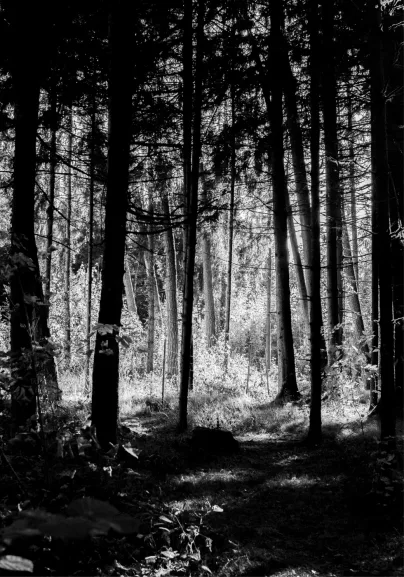
    Black-and-white photograph of a forest – symbolic image
    Forest – symbolic image.

    Györgyi Lachapelle was born in Budapest on 29 February 1924. She worked as a seamstress and lived there until 1944.

    On 23 October 1944 she was arrested and escorted to Kőbánya-Kispest railway station. Later that day, she was forced to march on foot to Ferihegy in the pouring rain with scores of other Budapest Jews, arriving there in the evening. The next day, the prisoners were taken to Budafok. “We spent two weeks there digging trenches, but we weren’t mistreated,” Györgyi is keen to stress. They were even given certificates of release, so they thought they might be able to go back home, but instead they were transported to a brick factory in Óbuda. Before the group arrived there, members of the national socialist Hungarian Arrow Cross Party confiscated all of their valuables. Numerous people were crammed together in the brick factory and again ordered to give up all their possessions. If any of them was found to be concealing more than 25 Pengő [note: the Hungarian currency from 1927 to 1946], they were shot dead. Györgyi saw crates of rings and watches that had been seized from the Jews.

    They then spent two weeks marching along the road to Vienna – and were not given a single thing to eat. At Hegyeshalom, they were handed over to the Germans, who put them into railway cars and gave them some rations for the first time. They were told that they were being transported to Germany, where they would work in factories and be well looked after.

    But the opposite was the case. In Kőszeg, they were divided up and taken to a women’s and a men’s camp in Bozsok. An acquaintance made sure that Györgyi was also allocated to the men’s camp, where she fared better than the others. But this did not last for long. At the end of February, she was transferred to Eberau, where they had to move felled trees to conceal trenches. She was completely exhausted by midday but her work continued until the evening.

    When the Russians advanced, they were ordered to set off on foot on 26 March 1945. There followed a long and terrible march on foot that lasted three weeks, where the prisoners were plagued by hunger and death. They collected snails, rapeseed and sorrel but couldn’t let the SS see, as anyone who stepped out of line was shot. When they crossed the Präbichl pass, their ranks dwindled. “At least 60 percent of us died on the march,” Györgyi said in a conversation she had with Klára Vincze after her return from the Holocaust in the office of the Hungarian National Committee for Attending Deportees (DEGOB) in Budapest, which was recorded.

    Györgyi continued: “We arrived in Mauthausen completely exhausted. We slept in the open air for four days because there was no space in the tents. The camp was surrounded by a barbed wire fence with a high voltage running through it. Guards with loaded guns were constantly stationed outside the fence. Anyone who came within a metre of the fence was immediately shot. The searchlights shone all night making it impossible to escape. Once, there was an aerial attack. A bomb landed right next to me and blew a man’s head off.

    Our daily rations consisted of half a litre of beet soup and 100 grams of mouldy bread. We did nothing all day. It was permanently cold. The sick were with us in one tent. There were 150 to 200 deaths a day. The corpses lay scattered around outside and there was a terrible stench from the dead bodies and the open latrines.

    A sergeant walked around with a stick as thick as your arm, hitting anyone who walked past him on the head with such force that their skulls shattered. He also hit women.

    There was one tap for water, but it was almost impossible to get to use it. It was outside, which meant you had to wash in front of everyone.

    At the end of April, we were ordered to set off on foot again. We marched for three days and many of our number were shot along the way. We arrived in Gunskirchen in the pouring rain. As it rained there virtually every day, the whole camp was a morass of mud that never dried out. The camp was located in the middle of a forest, where tall conifers blocked out all the sunlight. There was no water at all – not for drinking or for washing. The female prisoners were allowed to bathe twice a week in a nearby river.

    The accommodation was appalling. Two thousand people were crammed in each of the barracks. The only way to sit was in a crouched position. We were painfully hungry. Our daily ration consisted of 400 millilitres of soup and 100 grams of bread, but we didn’t even always get that. The SS men tortured the women. Once, a package of aid arrived from the Red Cross, but we only received one parcel between seven of us, and it had already been opened and had anything worth having removed from it. The whole place was swarming with lice. There were also huge numbers of typhus cases. Between 250 and 300 people died every day. Corpses lay all around. There were 25 to 30 deaths in each of the barracks every morning. A great many of the men were beaten to death by the SS guards. The dead were buried in an enormous mass grave in the forest. No one kept any records of them.

    On 4 May, we were liberated by the Americans.”

    Source

    • Györgyi Lachapelle. DEGOB protocol 1312. Translated from Hungarian using www.deepl.com, edited by Angelika Schlackl. URL: degob.hu, 18/08/2026.
  14. David ‘Dugo’ Leitner David ‘Dugo’ Leitner
    David ‘Dugo’ Leitner

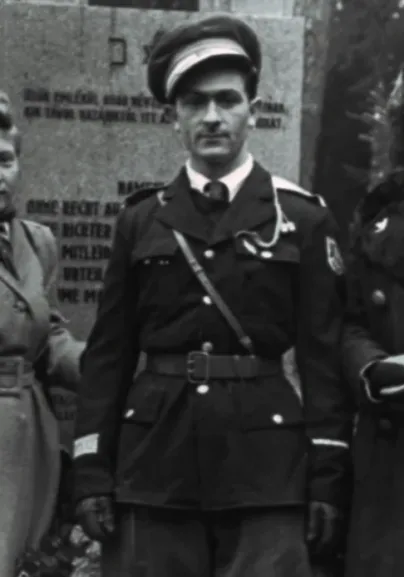
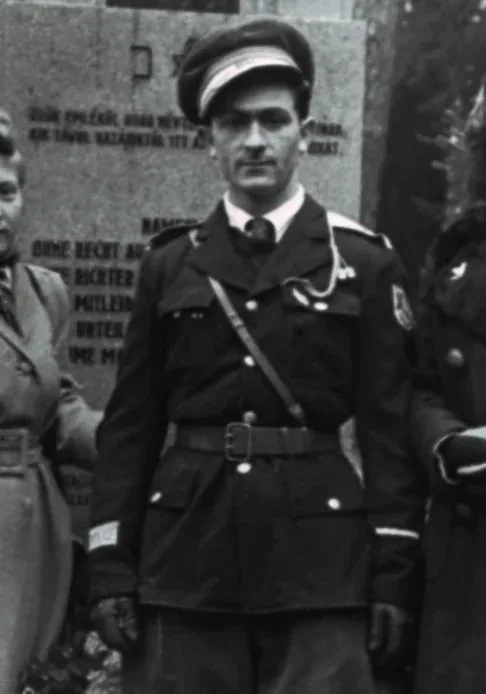
    David ‘Dugo’ Leitner was born in the city of Nyíregyháza in Hungary on 1 May 1930 as the second eldest son of Meir and Golda Leah Leitner. He grew up in an Orthodox Jewish family with his older brother Shmuel and his two younger sisters, Rachel and Esther. His parents ran a grocery shop. When war broke out in 1939, the situation for the Jewish population in Nyíregyháza became increasingly precarious. David’s father was forced to join the Hungarian Labour Service in the Ukraine. He was released from the Labour Service in March 1944 and returned home.

    Shortly afterwards, the German army invaded Hungary and the systematic rounding up of the Jewish population began. On the second day of Passover, the Leitner family was picked up by the police and moved to the Nyíregyháza ghetto. Six weeks later, the family was deported to the Auschwitz-Birkenau extermination camp. When they arrived there, the men and women were immediately separated.

    David’s mother and his sister Rachel were killed. His father and brother were deported to Buchenwald concentration camp, where his father was also killed. David remained in Birkenau with around 4000 children aged between 14 and 15. The SS put the young people to work in the ‘latrine forced labour detail’. One day, Josef Mengele selected 1400 younger children, who were all killed. David was chosen in one of the next selections. He was already inside the gas chamber with 500 other children when Mengele opened the heavy iron door and fetched out around 50 children – with David among them.

    Next, he had to work in the ‘potato forced labour detail’, until Auschwitz-Birkenau was evacuated on 18 January 1945. Exhausted and starving, on the death march to the Althammer satellite camp he dreamed of his favourite dish, his mother’s golden-brown bilkelach. The image of these traditional round Jewish rolls became a symbol of hope and survival for David.

    After a journey of several days in open cattle cars, he arrived at Mauthausen concentration camp on 30 January 1945, where he was given prisoner number 124929. In April, he was moved to the notorious tent camp, where he unexpectedly met his uncle Pinchas Leitner. His uncle had been transported to Mauthausen on a barge on the Danube, completely dehydrated and on the verge of starvation; he died the following day. Tortured by unimaginable hunger, David was ordered on another death march to the Gunskirchen satellite camp.

    David was liberated by American troops on 5 May 1945 and taken to Hörsching. For a whole month, he lay in the 121st Evacuation Hospital seriously ill and unconscious. After his recovery, he travelled back to his hometown on the roof of a train, where he was reunited with his brother Shmuel. His sister Esther did not return until two years later.

    In 1949, David and his brother immigrated to Israel. David founded an agricultural community, Nir Galim moshav, near the port city of Aschdod with Hungarian Shoah survivors. He also married his wife Sara there. In Nir Galim, David became one of the co-founders of Beit Haedut (The Testimony House), which became an important Holocaust memorial and educational institution in Israel. He was regularly involved there as a contemporary witness until the end of his life and he told his story to thousands of young Israelis.

    David began an unusual remembrance ritual many years ago. When he discovered falafels for the first time in a market in Jerusalem, the fried chickpea balls reminded him of his mother’s golden-yellow bilkelach. From then on, he made it a tradition to eat falafel on 18 January every year – the date on which the death marches began in Auschwitz – to celebrate his survival.

    This personal ritual developed into the #OperationDugo initiative that became known across the country. On the day of remembrance, David would sell falafels in a shopping centre, share his life story with young and old and emphasise the importance of the state of Israel as a safe haven for the Jewish people.

    David ‘Dugo’ Leitner died on 26 July 2023 at the age of 93. #OperationDugo has since been continued every year by thousands of people in Israel and around the world, helping to keep the memory of David and his message alive.

    Videos

    David Leitner – Biografie

    Source

    • Zehava (Leitner) Kor, DUGO, The True Story of David (Dugo) Leitner, EN-Edition, Jerusalem 2016; The International School for Holocaust Studies Yad Vashem, e-Learning Department, My Father’s Last Request. The Story of David (Dugo) Leitner, documentary film, Israel 2022.
  15. Michael (Shimon) Marton Michael (Shimon) Marton
    Michael (Shimon) Marton
    Michael and Sarah Marton Family Foundation

    Michael (Shimon) Marton ז״ל was born on October 5, 1923, in Viskovo, then Czechoslovakia, to Avraham Marton and Ella (Baila) Steinberger Marton. He was the eldest of six children and grew up in a deeply observant Jewish home and community. His memories of childhood included his family's home and garden, Shabbat and holidays, synagogue and Jewish study, school, skating and sports, and the surrounding mountains. As an avid reader and gifted student of mathematics, he had hoped to become an engineer. He was also drawn to Zionism from a young age and taught himself Hebrew because he dreamed of one day living in Eretz Israel.

    With the persecution of the Jews under Hungarian rule, Michael's education was interrupted and his family's security and livelihood were progressively stripped away. In 1944, his family was confined to a ghetto. Michael was subsequently taken into a Hungarian Jewish forced-labor unit, an event he remembered as the last time he saw much of his family. He was sent to Nagybánya, today Baia Mare, where approximately 240 Jewish young men in his group performed forced labor on railway lines.

    As the Soviet forces advanced, Michael and the other laborers were moved westward toward the Austrian border. He remembered that their Hungarian commander was sympathetic to the Jewish men, protected them when he could, obtained food for them, permitted them to pray during the Jewish holidays, and delayed for weeks an order to surrender them to the Germans. In January 1945, however, the group was finally handed over to German control.

    Michael was taken into Austria and forced to dig anti-tank fortifications at Wampersdorf. As the front approached, he was driven westward on a brutal death march toward Mauthausen. He remembered thousands of prisoners marching “like a herd,” shootings along the route, almost no food, inadequate clothing and shoes, bitter cold, snow and ice. At one point prisoners were forced to lie overnight on frozen ground; many of the elderly froze to death, while younger prisoners tried to keep one another alive with their body heat. Michael survived in part through the mutual assistance of friends with whom he shared what little they possessed.

    Michael ultimately survived the Death Marches to Mauthausen and from there to Gunskirchen and was liberated in 1945. Severely weakened by starvation and illness, he later recalled suffering from typhus and said simply of survival: “I was young and strong… You couldn't be smart. You just have to be stronger. Just lucky.” … Years later, the death march remained among his most vivid memories: “The snow, the ice, and how they were shooting at us.”

    After the war, Michael rebuilt his life. He lived among other Jewish survivors in displaced-persons communities, became involved in their organization and welfare, and continued to dream of going to Israel. Circumstances eventually brought him instead to the United States, where he arrived in April 1949 with little more than a suitcase and approximately $100. Through determination, ingenuity and extraordinary hard work, he built a successful business and became deeply involved in Jewish and communal life. He remained committed throughout his life to the teachings of Judaism, community institutions, education, philanthropy, and the State of Israel.

    Michael was a devoted husband, father, grandfather and great-grandfather. The family and Jewish future the Nazis sought to destroy became central to the life he created afterward. Although he found it painful to speak about the Holocaust and for many years spoke little about his experiences, he ultimately gave testimony so that what happened to his family and his generation would not be forgotten.

    Michael passed away on October 14, 2013 in New York, at the age of 90.

    His daughter, Elaine Diller, continues his commitment to remembrance through the Michael and Sarah Marton Family Foundation, including its support of the Gunskirchen memorial project. Michael's legacy lives not only in the testimony he left behind, but in the family, Jewish institutions, communities, education and acts of tzedakah to which he devoted his life.

  16. Therese Müller Therese Müller
    Therese Müller
    © Mauthausen Komitee Österreich

    Therese Müller was born in Jászberény, Hungary, in 1925 and grew up in a Jewish family.

    In the summer of 1944, when she was 19 years old, Therese was deported from Jászberény to Auschwitz-Birkenau. There she was selected on her arrival at the camp. Of the twelve family members with whom she had been deported, she was the only one to be selected for forced labour.

    From Auschwitz, she was taken to the Walldorf satellite camp near Frankfurt am Main, where she and other women, mainly Jews deported from Hungary, had to carry out forced labour. After that, Therese spent time at Ravensbrück and Mauthausen concentration camps and was transported to Mauthausen in a convoy of Red Cross buses. She survived the death march from Mauthausen to Gunskirchen and was liberated from there on 5 May 1945.

    Altogether, Therese Müller spent around ten months in various Nazi camps. She was the only one out of twelve family members to survive.

    After the liberation, Therese Müller travelled to Sweden, where she lived from 1951 onwards. She built a new life there and later worked as a doctor.

    For many years, she didn’t talk about her experiences. It was not until 1993 that her memoir was published in Swedish and then later in German too with the title Als junge ungarische Jüdin im Holocaust: Aus Jászberény durch Auschwitz, das KZ-Außenlager Walldorf beim Flughafen Frankfurt am Main, Ravensbrück, Mauthausen und Gunskirchen nach Schweden 1925–2007 [Experiencing the Holocaust as a young Hungarian Jew. From Jászberény via Auschwitz, the satellite camp Walldorf at Frankfurt am Main Airport, Ravensbrück, Mauthausen and Gunskirchen to Sweden 1925–2007].

    Therese Müller died in 2007.

    Photo source:

    Therese Müller: Als junge ungarische Jüdin im Holocaust. Aus Jászberény durch Auschwitz, das KZ-Außenlager Walldorf beim Flughafen Frankfurt am Main, Ravensbrück, Mauthausen und Gunskirchen nach Schweden 1925–2007. [Experiencing the Holocaust as a young Hungarian Jew. From Jászberény via Auschwitz, the satellite camp Walldorf at Frankfurt am Main Airport, Ravensbrück, Mauthausen and Gunskirchen to Sweden 1925–2007.] Konstanz 2014. P. 135.

    Source

    • Müller, Therese: Als junge ungarische Jüdin im Holocaust: Aus Jászberény durch Auschwitz, das KZ-Außenlager Walldorf beim Flughafen Frankfurt am Main, Ravensbrück, Mauthausen und Gunskirchen nach Schweden. 1925–2007. Konstanz 2014. S. 135.
  17. Avigdor Neumann Avigdor Neumann
    Avigdor Neumann

    Avigdor Neumann was born in Velká Sevljuš in the former Czechoslovakia on 31 July 1931. Today, the city is known as Vynohradiv and is located in Carpathian Ukraine.

    Avigdor was the fourth of seven children in the Hasidic family of Menachem Mendel and Bella (or Bila) Neumann. Avigdor was a very bright and lively child. If any of the children got up to something, he was always the one who got the blame. His father once said to him: “If you can stand still for five minutes, I will pay you for it!”

    Avigdor’s father was a wealthy businessman who traded in construction materials – his non-Jewish fellow citizens were happy to buy from Jews. The Neumann family was very religious and Avigdor attended a cheder (Jewish primary school) in the morning before joining his non-Jewish classmates at the state school.

    Following the First Vienna Award in November 1938, which redefined the borders between Hungary and Czechoslovakia, the city came under Hungarian rule and was named Nagyszőllős. When Hungary took over the government in 1939, this was also the beginning of the hostilities against Jews. Their businesses were closed and Jewish men were recruited for labour. In the streets, people pulled at their payots [sidelocks or sideburns], shouted “Scheiß Jude” (“Jewish shit”) at them or “Verschwinde und geh nach Palästina!” (“Get lost and go to Palestine”). The situation became increasingly worse when the Germans invaded Hungary on 19 March 1944. Jews had to wear the yellow Star of David, their assets were confiscated and they were moved to the city’s ghetto. On 22 May 1944, all the inhabitants of the ghetto were loaded into cattle cars and deported to Auschwitz-Birkenau. On the ramp, Avigdor’s father asked him to stay with his mother and help her with his younger siblings. A Jewish Kapo (prisoner functionary) knew what would happen to Avigdor if he did that and sent him to the men’s side. During the selection, he stated that he was 15 years old and familiar with machines. He was assigned to the ‘latrine detachment’. With a group of boys, he was harnessed to a cart, in place of horses, which they had to then use to take away any waste. When they came across potato waste, this then helped to supplement their meagre food rations.

    At the fence dividing their camp from the women’s camp, Avigdor came across his older sister Sima Rahel. He called to her: “I’m 13 today, it’s my bar mitzvah!” Wolfgang Sinai Adler, the son of a rabbi from Prague, heard Avigdor calling. He lent him his tefillin, the Jewish leather boxes containing Torah passages, which he was keeping hidden. Avigdor secretly put them on in Auschwitz for his bar mitzvah.

    By the time the extermination camp was evacuated, he had spent eight months there. After a death march lasting three days, he and thousands of other prisoners arrived in Stara Kuźnia (German: Althammer) in icy weather, where he was then loaded into a cattle car with lots of young people. On 30 January 1945, he arrived in Mauthausen, where he was registered as prisoner number 124954 and quartered in Block 10. He experienced extreme cold, terrible hunger and brutal violence from the SS, before being committed to the tent camp in April. Another death march to Gunskirchen followed. The final weeks of the war contained yet more indescribable suffering for the 14-year-old Avigdor, before he was then liberated by the Americans on 5 May 1945.

    Avigdor and his sister Sima Rahel were the only survivors from their family.

    Avigdor immigrated to Israel with his sister, where he met his future wife Ricka.

    Videos

    Avigdor Neumann – Biografie

    Source

    • The International Institute for Holocaust Education at Yad Vashem, “I Rose From The Ashes” – The Story of Avigdor Neumann. Jerusalem 2025. Summary: Angelika Schlackl.
  18. Ernő Rosenberg Ernő Rosenberg
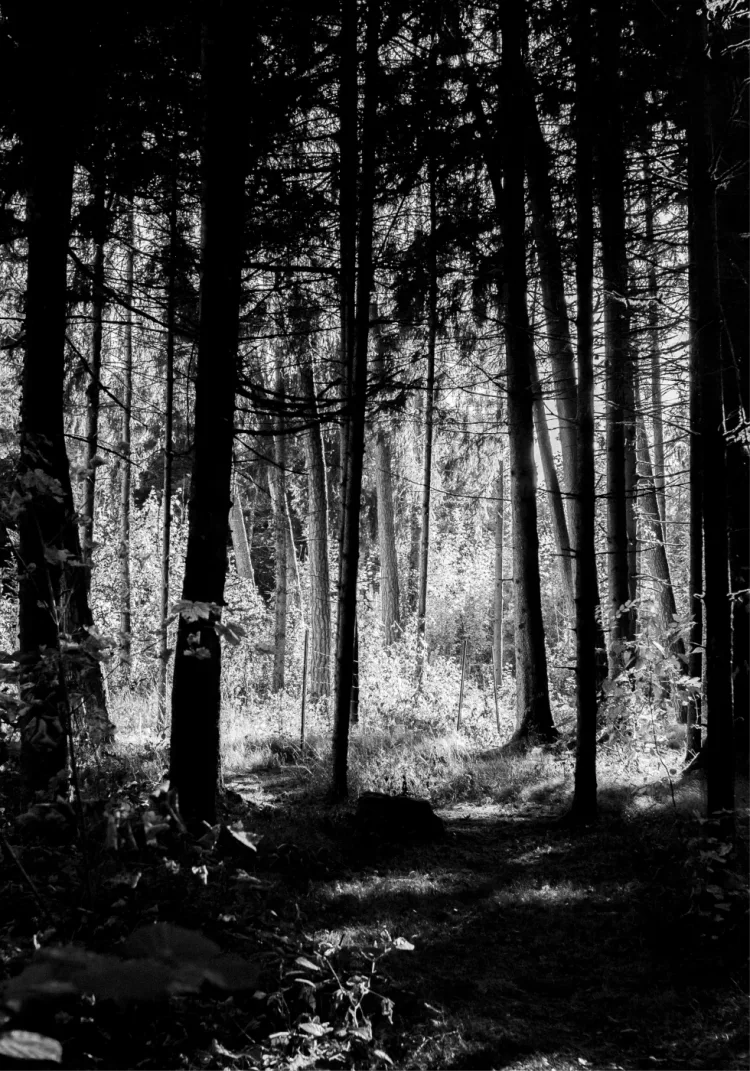
    Black-and-white photograph of a forest – symbolic image
    Forest – symbolic image.

    Ernő Rosenberg was born in the town of Szinérváralja, which is today known as Seini, in Romania on 1 March 1918. He lived and worked as a tailor’s assistant in Budapest.

    On 18 January 1943, he was ordered to the city of Nagybánya with a group of Jews to clear mines and roll up barbed wire fences. His company was accused of being communists, attacked as “damned Jews” and threatened with being sent to Ukraine. In November of the same year, they were in fact deported to Ukraine as a company of miners, “where they would never again see daylight” as their company commander from Budapest predicted. He was of German origin and a “regular Jew killer”, in Ernő’s words. The next legs of their journey took them to Kolomea and Nadwórna. They had to work 18 hours a day and received very little in the way of rations. They were constantly beaten and subjected to anti-Semitic abuse.

    For a short time, Ernő’s company found themselves right at the Russian front, where he and his companions were treated slightly more humanely. After they left the front, however, the anti-Semitic abuse began again. When Ernő was wounded, he was taken by hospital train to Miskolc. Following his recovery, he rejoined his company in Nagybánya, where the Jews were again subjected to abuse. They were then sent on an odyssey from one place to another – to Ferihegy airport in Budapest, on to Újpest, and then to Vác and Budafok. In the barracks there, Ernő’s company experienced terrible ordeals: one Sunday morning, the barracks were surrounded by guards armed with bayonets. Then the next day at 2 o’clock in the morning, the whole company was escorted to the police station in Józsefváros and loaded into railway cars. Following a six-day journey with nothing to eat or drink, they were then loaded into sealed railway wagons and crammed together with 80 people as far as Hegyeshalom. At this railway station on the border with Austria, they were robbed of all their belongings by the German rural police. They were left with nothing but the clothes on the back and their shoes. In Bruck an der Leitha, they were handed over to the German police commissars. They worked between eight and ten hours a day in the most appalling conditions. They had to clear a forest, shovel coal and clear snow. When the front moved closer, they marched on foot to Deutsch-Altenburg, where they met a group of 1500 deportees from Engerau, who told them that many of their comrades had been shot and killed on the way there.

    They were loaded onto a barge and then endured an eight-day journey by boat to Mauthausen. Ernő explained that there were no rations provided during the journey. In their desperation, they scooped water from the Danube river to drink. The group reached Mauthausen completely exhausted. Of the total of 3000 people who started out on the journey, only between 1800 and 2000 were still alive. The others had starved to death or been shot and killed. Anyone who was unable to climb out of the barge in their exhausted state was also shot.

    The prisoners were marched into the Mauthausen camp under armed SS guard. Along the way, they collected numerous corpses on three lorries, Ernő recalls. One morning, a transport was dispatched from Mauthausen to Dachau. But there was no space for the new prisoners at Dachau. So they came back to Mauthausen and were assigned to the overcrowded tent camp. There Ernő witnessed how mountains of corpses were carried away every day.

    Ernő Rosenberg described how between 4000 and 5000 people were ordered out of the tent camp on forced marches to the Gunskirchen satellite camp every day. No rations were provided during these marches, so the prisoners, tormented by their hunger, resorted to eating grass, alfalfa and snails.

    The U.S. liberators arrived on 5 May 1945. The U.S. soldiers gave out large quantities of food, but Ernő sadly witnessed many of his comrades collapse and die as their bodies were simply unable to tolerate the food after such a long period of malnutrition. Ernő was suffering with typhus, so was taken to Wels for medical treatment and returned to Budapest in October 1945 following his recovery. In his search for accommodation, supplies and family members, he turned to the National Committee for Attending Deportees (DEGOB), a Hungarian Jewish aid organisation for deportees in Budapest. On 11 October 1945, he was asked about his experiences in the Holocaust by a DEGOB employee to collect information on the crimes and their perpetrators. Ernő Rosenberg was one of 824 survivors of the Gunskirchen camp to be interviewed. His account was recorded in the DEGOB protocol no. 3395.

    Source

    • Ernő Rosenberg. DEGOB protocol 3395. Translated from Hungarian using www.deepl.com, edited by Angelika Schlackl. URL: degob.hu, 18/08/2026.
  19. Shaul Spielmann Shaul Spielmann

    Shaul Spielmann was born on 1 July 1931 in Vienna, Austria, the only son of Benjamin and Josefine Spielmann. His father served as an officer in the Austrian Armed Forces and was working at the time as an engineer at the Viennese electricity board. His mother received her musical training at the Conservatory of Vienna.

    After the Anschluss (annexation) to Nazi Germany in 1938, the Spielmann family’s life changed abruptly. They had their valuables confiscated by the Nazis, had to leave their apartment in the 16th district without their belongings and then lived in fear and poverty in the Fleischmarkt street in the 1st district. Late at night on 2 October 1942, the family was arrested by the Gestapo and deported to Theresienstadt two days later.

    Shaul Spielmann mit seiner Schwester
    Shaul Spielmann mit seiner Schwester

    In mid-November 1943, they were deported to the Auschwitz-Birkenau concentration camp and extermination camp together with 5,000 other prisoners and family members. Their transport did not undergo any selection process and they were housed in the B camp – but only for six months. The families were all kept alive in order to be able to claim in the event of a visit by the Red Cross that no extermination was taking place at Auschwitz.

    Both parents were ultimately murdered and Shaul remained in Auschwitz with other young boys for another year – with the number 170775 tattooed on his left arm. He survived terrible death marches in freezing temperatures and returned to Austria as a prisoner in February 1945.

    As prisoner no. 118298, he was initially deported to Mauthausen in the final months of the war. His journey eventually took him via Melk concentration camp to Gunskirchen satellite camp, where the conditions for the prisoners became increasingly worse.

    On 5 May 1945, his period of suffering came to an end when U.S. troops liberated the camp.

    Shaul Spielmann beim Fest der Freude 2016

    Shaul Spielmann beim Fest der Freude 2016
    © Sebastian Philipp

    Shaul mainly spent time recovering in Israel after the war. He built a new life there and started his own happy family.

    During his most recent visits to the liberation ceremonies in Mauthausen and Gunskirchen and to the Fest der Freude (Festival of Joy) in Vienna, Shaul Spielmann spoke to young people as a survivor and contemporary witness and shared his experiences during the Nazi terror.

    Shaul Spielmann lives in Israel to this day.

    Videos

    Shaul Spielmann – The way to Gunskirchen – Civilian Population

    Shaul Spielmann – The concentration camp

    Shaul Spielmann – On the grounds of the former satellite camp, in the area of the barracks

    Shaul Spielmann – Conditions in the Camp

    Shaul Spielmann – Speech at the U.S. Army memorial stone during the “Walk of Solidarity” as part of the liberation ceremony

    Shaul Spielmann – Gunskirchen satellite camp

    Shaul Spielmann – Speech at the U.S. Army memorial stone during the “Walk of Solidarity” as part of the liberation ceremony

    Shaul Spielmann – The Way to Hörsching

    Sources

    • MKÖ: Interview mit Shaul Spielmann. Mauthausen Komitee Österreich. Wien 2017.
    • MKÖ/ORF: Interview mit Shaul Spielmann. Mauthausen Komitee Österreich/Österreichischer Rundfunk. Wien 2016.
  20. Willie Sterner Willie Sterner
    Willie Sterner
    © Mauthausen Komitee Österreich

    Willie Sterner was born on 15 September 1919 in Wolbrom, Poland, where his father was a painting contractor. He was the eldest son of Hersz Leib und Hinda Reizel Sterner. Willie had six siblings: Yosel Meier, Abraham, Ida, Genia, Rachel and Sarah. In 1929, the family moved to Kraków and Willie attended the vocational school for painting and arts and crafts. On leaving school, he joined his father’s painting business. They decorated houses, theatres and synagogues. Willie was a member of the Zionist youth group Akiva and the Maccabi boxing club. Relations between Jews and non-Jews at that time were not particularly warm, but as liberal Jews, the Sterners fared better than more religious Jews.

    However, their situation altered significantly with the German invasion of Poland in September 1939. Willie was sent to the Pustków labour camp and put to work felling trees and cutting lumber. Some time later, he escaped and returned to Kraków, where he found painting work to support himself. In early 1941, Willie’s father moved the family back to Wolbrom, where Willie and his brothers were given work as painters for the commanding officer of the local ghetto.

    When the first round-ups began in 1942, Willie’s mother and sisters were deported to Treblinka, where they perished. The rest of the family was then resettled to the Kraków ghetto. Since they were sent without any belongings, Willie was given permission to return to Wolbrom to retrieve the family’s clothing. Once back in Wolbrom, he was denied permission to return to Kraków. At this point Willie went into hiding with a Pole named Kazia Strzalka, who lived nearby. While in hiding, Willie learned that his father and brothers had been deported from Kraków. After hearing the news, Willie lost the will to live and gave himself up to the Germans, who sent him back to Kraków. For the next few months, Willie was a forced labourer at the airport. When the Kraków ghetto was liquidated in March 1943, Willie was among the 8,000 Jews who were sent to the Płaszów concentration camp.

    One day, Oskar Schindler came into the camp. He needed a professional painter and Willie was placed at his disposal. Schindler gave Willie the special task of restoring his paintings, but while Willie was carrying out this work, his name somehow missed being included in Schindler’s famous list. When Schindler’s enamel factory was closed, Willie had to go back to Płaszów and was deported to Mauthausen with 4,589 Polish Jews on 8 August 1944. He was registered as prisoner number 88163 and laboured in the Wiener Graben quarry for three weeks. At the end of that time, he was transferred to the ‘Bergkristall’ detail at Gusen II as a painter and varnisher. He painted aircraft parts in one of the tunnels there. His foreman, a German, was also a painter by profession and was very impressed with Willie’s work. When Willie passed out one time from the toxic fumes from the paint sprays, he saved him from being shot dead. He even asked Willie to paint his private room at the back of one of the barracks. Willie demonstrated his true mastery of his craft through his ability to mix colours from simple ingredients. He was so skilled at this that other members of the block staff also called on his services. It was this painting work that helped to ensure his survival in the infamous Gusen II camp.

    On 24 April 1945, Willie was sent back to the tent camp at Mauthausen with 846 Jews from Gusen, only to be evacuated a short time later on a forced march to the Gunskirchen satellite camp. On the way there, he met Eva Mrowka, who had been born on 11 November 1925. She was from the Polish city of Sosnowiec, where the Sterners had relatives. But they became separated at the Gunskirchen camp.

    When Gunskirchen was liberated on 5 May 1945, Willie set off on foot for Wels, along with thousands of survivors. Seriously ill with typhus, he wandered around in the city until late at night – before being picked up by a U.S. soldier and billeted in a private house. After a few days, Willie reported to the United Nations Relief and Rehabilitation Administration (UNRRA) in the Herminenhof building in Wels and was transferred to the infirmary at the Lichtenegg camp. There was no bed for him there so he had to lie on the floor. He was deeply afraid that, having regained his freedom, he might not now get the chance to enjoy it.

    But he overcame typhus and went back to the UNRRA in the hope of finding other family members who might still be alive. While he was there, a young, blonde girl suddenly entered the building and was immediately surrounded by a group of overjoyed friends. Afterwards, she turned to Willie and greeted him by name. It was Eva Mrowka, whom he had met on the death march. She looked beautiful! Eva and Willie became a couple and were married in Salzburg in July 1946.

    Willie Sterner was called as a witness at the Mauthausen trial in Dachau in 1946. But he was very disappointed not to get an opportunity to make a statement on the crimes of the perpetrators at Mauthausen, Gusen and Gunskirchen. As far as he was concerned, the trial was a “circus”.

    That same year, he and his wife Eva moved to the Linz-Bindermichl displaced persons camp as Willie had been given a position as chief of police in Linz. While they were living in Linz, they visited the mass graves in the woods to remember the many victims. But as Jews, they didn’t feel comfortable or safe enough to remain in Linz. They immigrated to Canada in 1948.

    Willie Sterner died on October 4, 2011, in Montreal.

    Source

    • Willie Sterner, The Shadows Behind Me, Toronto 2010.
  21. Stephan Virányi Stephan Virányi
    Black-and-white photograph of a forest – symbolic image
    Forest – symbolic image.

    Stephan (István) Virányi was born in Hungary in 1925. He was forced as a Hungarian forced labourer to build the Südostwall on the border between Hungary and Austria. When these works were stopped, Stephan was forced with thousands of other prisoners, mainly Hungarian Jews, on a death march across Austria to the tent camp of Mauthausen concentration camp. From there, at the end of April 1945 he was ordered on another death march to the Gunskirchen satellite camp.

    When Gunskirchen satellite camp was liberated by the U.S. army, Stephan Virányi returned to Hungary and spent time living in Budapest and in the city of Vác.

    Sources

    • Kammerstätter, Peter: Der Todesmarsch ungarischer Juden von Mauthausen nach Gunskirchen im April 1945. Materialsammlung, Linz 1972.
    • https://nevek.hdke.hu/en/person/124765 [abgerufen am 29.09.2026]