Edith Eger
Edith Eger – The way to Gunskirchen
Source: Interview Edith Eva Eger

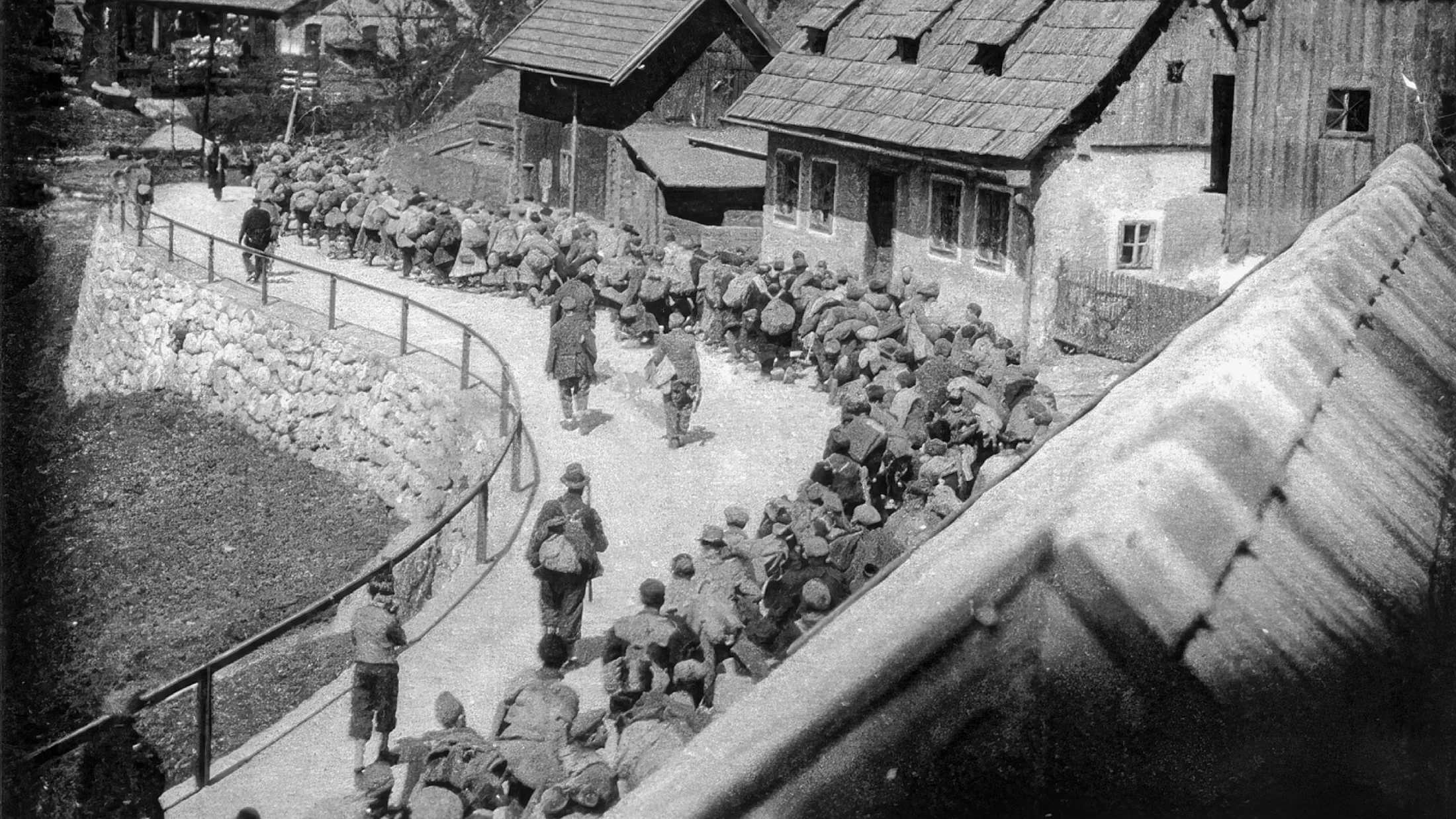
Station 1
Private collection Walter Dall-Asen, Hieflau (detail)
In autumn 1944, the Nazi regime began building the Südostwall (South-East Wall), a defensive system of fortifications along the present-day borders between Austria and Slovakia and between Austria and Hungary. The purpose of these fortifications was to stop the advancing Soviet Army. Their construction was largely carried out by Hungarian Jewish forced labourers.
As the Soviet Red Army advanced further and the Nazi command realised the hopelessness of the military situation, the forced labour camps for the construction of the Südostwall were closed. At the end of March and in early April 1945, shortly before the end of the Second World War, thousands of weakened Jewish prisoners from camps for the building of the Südostwall, various forced labour camps and concentration camp satellite camps in and around Vienna were ‘evacuated’ to a tent camp at Mauthausen concentration camp. The prisoners were mainly men, but there were also women and children. At the hugely overcrowded tent camp at Mauthausen concentration camp, there was a lack of food, water and sanitary facilities and little protection against the cold. Survivor Daniel Chanoch later remembered: “If Mauthausen was an inferno, then there is no word in the human dictionary to describe that tent camp.” Many prisoners were not registered so the precise number of people interned in the tent camp at Mauthausen concentration camp is not known.
“At the end of April 1945, when it seemed like things couldn’t get any worse, the children were given the order to begin another march to the west. The destination […:] Gunskirchen, the greatest terror of everyone […].”
Daniel Chanoch 1
From 15 to 28 April 1945, death marches to Gunskirchen set off from the tent camp on an almost daily basis. Between 17,000 and 20,000 mainly Jewish concentration camp prisoners – men, women and children – had to walk the roughly 55-kilometre route in three days. They were accompanied by guards from the SS, the police, the Volkssturm (national militia), the Hitler Youth and other armed units.
The prisoners were completely exhausted. Very few of them still had shoes, they had to sleep outdoors and they were given little in the way of food or water. To survive, they ate grass, plants, snails and worms. If they could not go on or left the column, they were usually shot. Mass graves and memorials along the routes taken by the marches act as reminders of the victims.
When the survivors reached Gunskirchen, they found unfinished wooden barracks with no sanitary facilities – the camp in the forest was far from finished.
References
The concentration camp prisoners who arrived at the Gunskirchen satellite camp in April 1945 had already suffered terrible ordeals including being deprived of their rights, persecuted, forced to live in ghettos and deported.
They were driven in death marches or carted in transports from various places across the former German Reich and brought to Gunskirchen.
With the advance of Soviet troops in 1944, the Nazi regime began constructing the Reichsschutzstellung (Reich protection position), also referred to as the Südostwall (South-East Wall). This stretched from Bratislava to Radkersburg, roughly following the line of the present-day borders between Austria and Slovakia and between Austria and Hungary. The Südostwall was built using forced labour, which was mainly carried out by Hungarian Jews. Civilians, the Croatian Waffen-SS, the Volkssturm, the Hitler Youth, the SA and prisoners of war were also involved in building the tank traps and fortifications that made up this defensive line.
This construction – which was largely pointless from a military point of view – was created under completely inhumane conditions. Hunger, disease, brutal treatment and a complete absence of any medical care were the cause of countless deaths. The construction work was also carried out under extreme time pressure.1
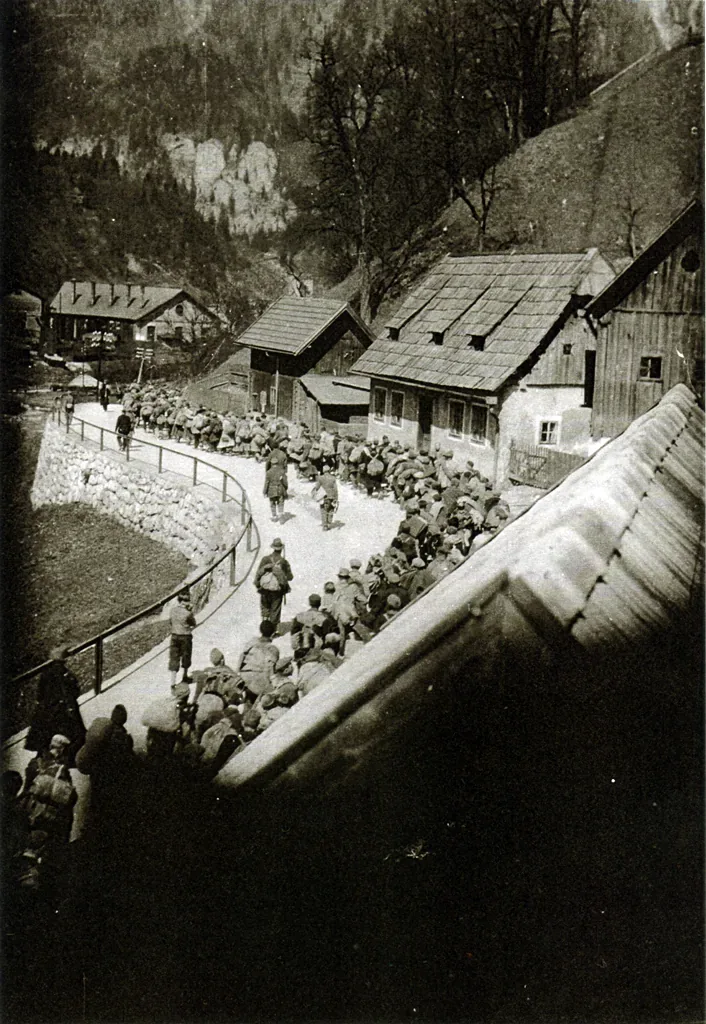
As the Soviet Red Army advanced further and it became clear that the Nazi regime would be militarily defeated, the decision was taken to close the forced labour camps for the construction of the Südostwall and drive the weakened Jewish prisoners on death marches across Austria to Mauthausen concentration camp. On 29 March 1945, they were driven first to Graz and then in early April 1945 they were driven in groups of 500 to 2000 people from there on to Mauthausen concentration camp. The starving and emaciated Jewish prisoners had to cover a distance of around 40 kilometres per day – closely watched and guarded by the SS, Volkssturm units, the Hitler Youth and other units organised by local officials.2 According to a statement by the commandant of Mauthausen, Franz Ziereis, around 60,000 Hungarian Jews were to be brought to Mauthausen. In the end, only around 17,000 to 20,000 people actually arrived there.
“We are all young. There are only young people left now. It is terrible to see that they are all young people – the same age as me. The roadside ditches are filled with the dead bodies of 19 and 20-year-olds. I will never forget that sight as long as I live.”
Therese Müller 3
The local population were strictly forbidden from helping the prisoners in any way. In their desperation, the prisoners ate grass, worms and snails. Attempts to escape or even just take an unauthorised rest at the side of the road were punished with violence and death. The prisoners were driven to Mauthausen, where they were then housed in the so-called ‘Zeltlager’, the tent camp, via various routes. These included a route via Präbichl, where a terrible massacre was carried out against the prisoners, through the Ennstal valley, the Steyrtal valley and over the Pyhrn Pass.4
In the tent camp of Mauthausen concentration camp, prisoners arriving from the camps of the Südostwall came together with prisoners from various forced labour camps and Mauthausen concentration camp satellite camps, including Gusen, Melk, Wien-Floridsdorf, St. Valentin and Amstetten.
Many of the inmates who were housed in the tent camp were not registered. It is therefore no longer possible to establish exactly how many people were actually interned there. But one thing is certain, the living conditions in the hugely overcrowded camp were absolutely disastrous. The concentration camp prisoners received scarcely any food and there were no sanitary facilities at all.5 Survivor Stephan Virányi describes the conditions as follows: “The tents were designed for a maximum of 800 people each, but more than 2,000 people were crammed into a tent. […] We were already heavily infested with lice when we were in Bruck, but this increased in Mauthausen to the point where it was almost unbearable.”6
Survivor Daniel Chanoch later summed up his memories of the tent camp as follows: “If Mauthausen was an inferno, then there is no word in the human dictionary to describe that tent camp.” Daniel Chanoch also reported that in some cases human remains were cooked into a form of soup by the prisoners. The bitter cold meant that blankets in particular were highly prized and heavily fought over. Inmates frequently stole them or defended them with their lives as losing one was tantamount to a death sentence.7
“Each hour, hundreds of girls fall into the ditches on either side of the road. Too weak or too ill to keep moving, they’re killed on the spot. We are like the head of a dandelion gone to seed and blown by the wind, only a few white tufts remaining. Hunger is my only name.”
Edith Eger 8
From mid-April 1945 onwards, prisoners from the Mauthausen tent camp and Gusen concentration camp were marched to Gunskirchen in several columns. The final weeks of the war were so chaotic that it is not possible to fully piece together the precise operations and figures. But it has been established that multiple death marches set off from Mauthausen towards Gunskirchen between 15 and 28 April 1945. Around 17,000 to 20,000 mainly Jewish concentration camp prisoners were forced to go through this ordeal.9 The march on foot to Gunskirchen, a distance of around 55 kilometres, was covered in three days.
Michael Kraus – The way to Gunskirchen
Nicholas Halmay – The way to Gunskirchen
The route of the death marches led to Ennsdorf and from there on to Enns, Kristein, Asten, St. Florian, Ansfelden, Weißenkirchen and Wels. For some of the groups, though, the route was changed due to complaints from residents in the area around Asten, and the march was directed via St. Marien and Neuhofen an der Krems instead.10
The prisoners were accompanied by guards made up of the Waffen-SS and firemen, the rural police, the Viennese police and the Volkssturm (national militia). Their treatment of the prisoners was similar to that of the guards on the death marches to Mauthausen and was marked by excessive violence and ruthless brutality. Very few of the prisoners still had shoes and they had to sleep outdoors in meadows. They were given scarcely any food or water. They ate rapeseed from the fields, nettles, grass, snails and worms or any remnants of potatoes and beet they found in the fields. But if the concentration camp prisoners were caught leaving the organised march column without permission by their supervisors, then they would not hesitate to shoot them. The majority of the bodies of those murdered on the death marches were simply left behind. To this day, there are still mass graves in various communities along the routes.11
Helen Balsam – The way to Gunskirchen
Hugo Gryn – The way to Gunskirchen
Yehuda Gurvich – The way to Gunskirchen – Guards
In Ennsdorf, the first town the march reached after crossing the Danube river in Mauthausen, at least 33 Jews were murdered. But a local resident interviewed by Peter Kammerstätter in the early 1970s reported that there were probably more human remains “buried in the fields and meadows”. She recalled: “You heard shots ringing out again and again. The corpses lay all the way from the Mauthausen Bridge up the hill. Initially, they were buried where they lay, and then later the former Nazis had to dig them up and bury them in a mass grave that had been created in the former mayor’s meadow. I find it unlikely that all those who were killed back then were laid to rest in the meadow.”12, 1972, P. 33. quelle: kammerstaetter-1972)
From Ennsdorf, the march continued over the Ennsbrücke bridge into the town of Enns. One local witnessed a particularly cruel act there: “Once, on my way home I saw a member of the Volkssturm shoot dead a Jewish woman who was carrying a small child in her arms. He then killed the child with the butt of his gun. Apparently he was in charge of this transport.”13, 1972, P. 37. quelle: kammerstaetter-1972)
Two mass graves were created at the Enns-Lorch cemetery. According to the report by the municipality of Enns to the district authority of the province of Linz of 17 March 1947 a total of 87 people were buried there. The wife of the former gravedigger of the Enns-Lorch cemetery recounted: “There was a pile of concentration camp inmates in the cemetery again. And next to it lay seven or nine soldiers of the German Wehrmacht who were shot on Aichberg, we were told, for subversion of the Wehrmacht or desertion.”14, 1972, P. 40. quelle: kammerstaetter-1972)
Another route led from Enns via St. Florian and on towards Gunskirchen. There, the prisoners had to spend a night outdoors under the former ‘brick kilns’.
A contemporary witness recalled: “I remember it still – it was a very hot day. The prisoners were hugely thirsty so some of them tried to get to the village well. A few succeeded in getting some water.” Another contemporary witness reported that prisoners were also shot trying to drink from the village well.15, 1972, P. 54. quelle: kammerstaetter-1972)
Other local residents described the death marches as follows: “There were several columns. And they were herded through the town not just on a single day but on several days. They rested and slept at a brickyard, in other words behind the brickworks. They spent the night outside.”16, 1972, P. 54. quelle: kammerstaetter-1972) The prisoners also slept in the Stiftstadl (the abbey barn) and in the ‘Rübenspitz’ field. Any prisoners who couldn’t go on were murdered there17, 1972, P. 56. quelle: kammerstaetter-1972) and buried within the municipal boundaries.
On 19 April 1945, a column of around 5,000 people marched via St. Marien and Neuhofen an der Krems towards Gunskirchen. In St. Marien, the farmers Emilie Krška and Maria Ruprechtsberger took in a Jewish prisoner and hid him until the end of the war.18
The prisoners continued marching via Neuhofen and camped in the ‘Leitnerholz’ forest in Guglberg. Today, a memorial commemorates the at least 24 corpses that were collected and buried after the prisoners had marched through.19
Yet another route led from Enns via Asten, where the local residents complained so bitterly about the prisoners marching through their town that, from then on, the route was directed via St. Florian. From there, the march continued to Ansfelden.20 A former undertaker from Ansfelden explained: “It was my job […] to collect the corpses. […] I think the first time I put six or seven corpses on the hand cart and took them to the cemetery. The second time, I collected seven or eight corpses. All in all, it was probably about 15 corpses.”21
From Ansfelden, the route led to Pucking – where 109 corpses were found buried in mass graves – and on to Weißenkirchen, where the prisoners spent the second night. There the various routes came together again. Several hundred dead were found buried in mass graves in the Weißenkirchen municipal area.22
Shaul Spielmann – The way to Gunskirchen – Civilian Population
The final stage led via Schleißheim and Thalheim to Wels. The Schleißheim parish chronicles report that ten thousand people were marched through the municipal area in mid-April. They state that: “Sometimes they also camped in the meadow. They were mainly Jews. If they couldn’t go any further from pure exhaustion then they were simply shot by the guards. Over 20 people were shot in this way in a single day during the march from Ditach to Forsting. They were buried in the meadow.”23 Altogether around 150 prisoners were buried in three mass graves in Schleißheim.24
Marching along the Traun river, the prisoners finally arrived in the city of Wels via the town of Thalheim. After a death march lasting several days, they arrived in the forest camp of the Gunskirchen satellite camp in April 1945.
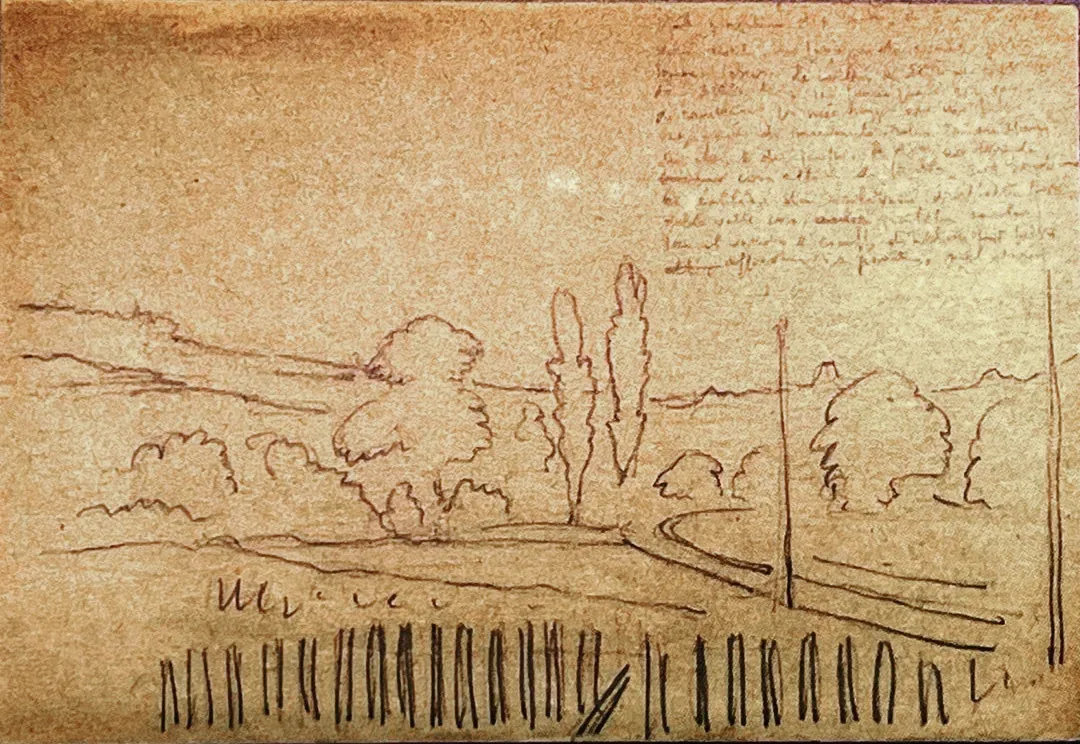
“The forest began to thin out. We approached log cabins surrounded by guards. Was this supposed to be a camp? It was awful!”
Michael Kraus 25
The prisoners eventually arrived at a very temporary camp in the forest near Gunskirchen. The construction work had already been begun by a building detachment in the preceding months, but when the thousands of prisoners arrived it was a long way from being completed.
Around 400 Polish, French, Belgian and Russian prisoners26 from the Mauthausen stalag camp, all men and boys, had to carry out the forced labour to build the camp from 27 December 1944 onwards. They were housed in the Alte Volksschule (old primary school) in the centre of Gunskirchen. From there, they were marched into the ‘Hochholz’ part of the forest every day to build the forest camp. The building detachment that initially comprised around 200 prisoners was expanded to around 400 concentration camp prisoners at the beginning of 1945. The work detail commander was SS-Hauptscharführer (Head Squad Leader) Heinrich Häger and the supervision of the works was the responsibility of SS-Unterscharführer (Junior Squad Leader) Paul Anton Kaiser.27
When the death marches reached Gunskirchen, the camp was not ready to receive thousands of people. The hunger, violence and exhaustion those who arrived there had experienced had taken its toll. Many of them would never leave the camp alive.
References
Edith Eger – The way to Gunskirchen
Source: Interview Edith Eva Eger
Explore individual locations in three dimensions.
Opening this view loads external content.
Open view in a new tabcontinue to