Jehuda Gurvich
Yehuda Gurvich – Speech at the U.S. Army memorial stone during the “Walk of Solidarity” as part of the liberation ceremony
Source: Interview Jehuda Gurvich

Station 3
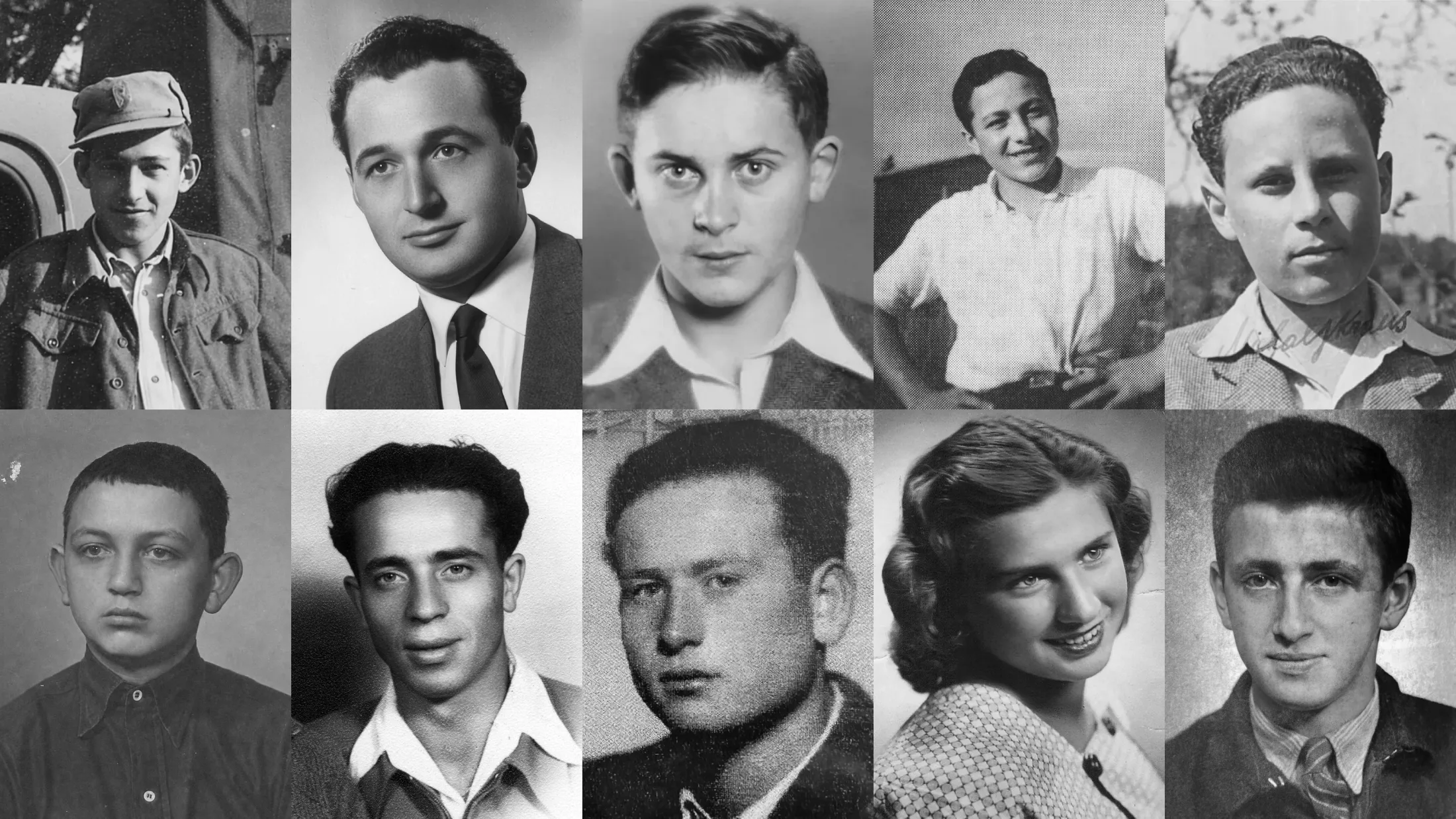
All youth photos: Angelika Schlackl
“Gunskirchen – the peak of suffering and torture, the ultimate agony and humiliation, the culmination of a blood-drenched journey, its final destination and its final result.”
Sinai Adler 1
In April 1945, the conditions in the forest camp near Gunskirchen were inhumane. The camp was also not finished. Many of the barracks had no roofs and there was a major lack of sanitary facilities with only two latrines available for around 20,000 concentration camp prisoners.
The camp was not a labour or death camp in the conventional sense but a place to die. At the Gunskirchen satellite camp, there were “no gas chambers [...], no crematoria. But there is no doubt that we have been sent here to die,” wrote survivor Edith Eger. For concentration camp survivor Michael Kraus, it was “the camp of the dead, forgotten among the trees of a dense forest, without air and without sun. Huge puddles surrounded the barracks.”
The camp was extremely overcrowded. Several thousand people were crammed into rooms that were built for a few hundred people. Many of them could hardly move. There was little semblance of a daily routine. Life in the camp was marked by hunger, thirst and sickness. Lice and typhus quickly spread and there was no medical care. Violence and capricious behaviour by the SS guards were daily occurrences. The very meagre rations consisted of water and the smallest quantities of bread; often, the prisoners received nothing at all. One particular sadist is burned in the memory of concentration camp survivor Jehuda Bacon: “He took the loaves of bread provided for us [...] wrapped them in a blanket and stamped on them.” The concentration camp survivor Dugo Leitner described how “they also ate the bark on the logs.” And Shaul Spielmann, who survived Gunskirchen, described how they “collected water from the roofs”, from which he contracted a severe form of typhoid fever. Survivor Willie Sterner recounts: “We did not receive any medical care. The lice were unbearable.” Some survivors reported cases of cannibalism among the concentration camp prisoners.
“They collected rainwater from the roofs of the barracks in large containers. We drank from them. The rainwater wasn’t particularly clean. That was probably how I contracted paratyphoid fever, a very severe form of typhoid fever.”
Shaul Spielmann 2
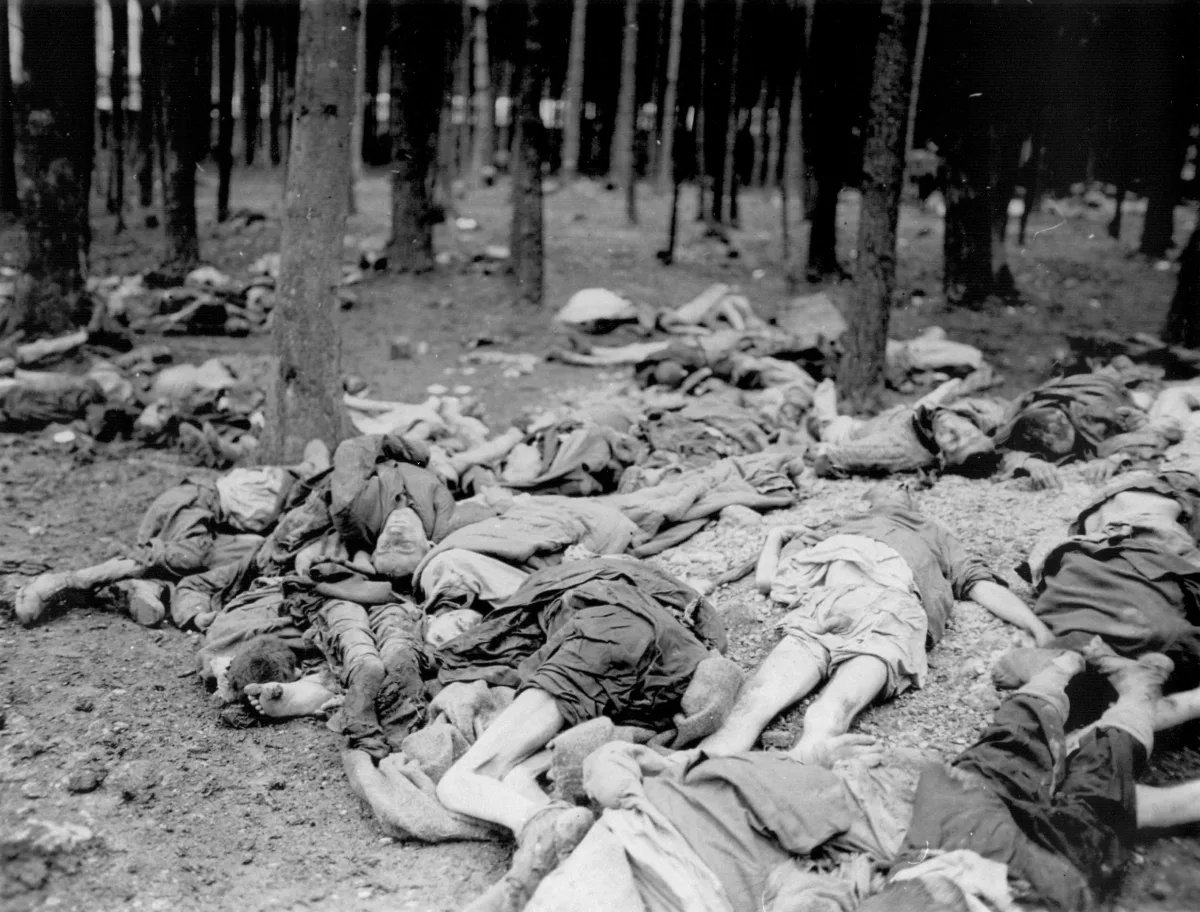
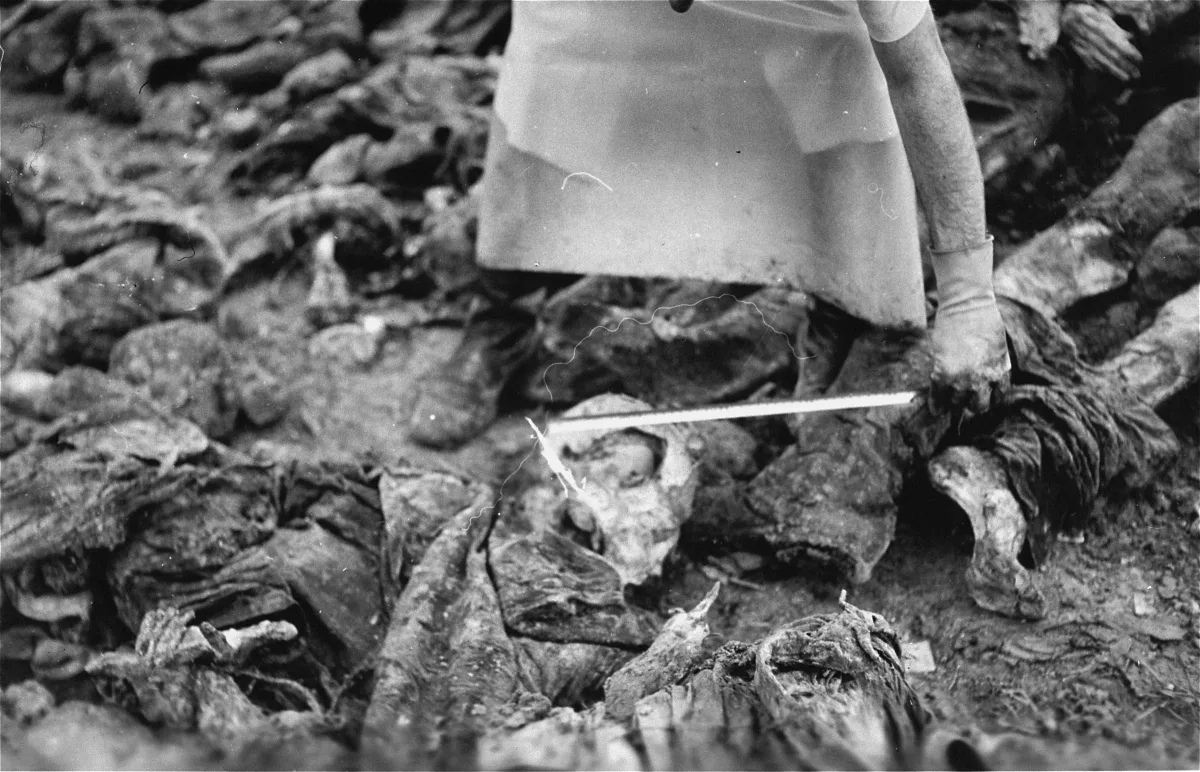
The sick and dying often remained lying where they fell; many of the dead were simply left lying on the forest floor or had to be buried by other prisoners in mass graves. “The only work in the camp was in the burial detachment,” wrote concentration camp survivor Joseph Fisher: “Some people had to collect the dead bodies and others had to bury them.” Often the prisoners had no other choice but to sleep on top of the dead bodies that lay in the barracks or sit in between them, as they simply didn’t have the strength to carry them outside. Burial of the bodies was forced labour that was carried out at Gunskirchen satellite camp by what was known as the burial detachment. Concentration camp survivor István Erdős recalled: “The corpses were piled up in heaps next to the latrine. Later, we dug pits with space for 40 bodies and buried them in them, of course without keeping any kind of record.” Survivors József Braun and István Klein also had to dig graves for 40 bodies: “If there weren’t 40 corpses for each grave, then the missing number was added.”
Shortly before the liberation, the supplies collapsed completely and the last SS units left the camp on 3 May.
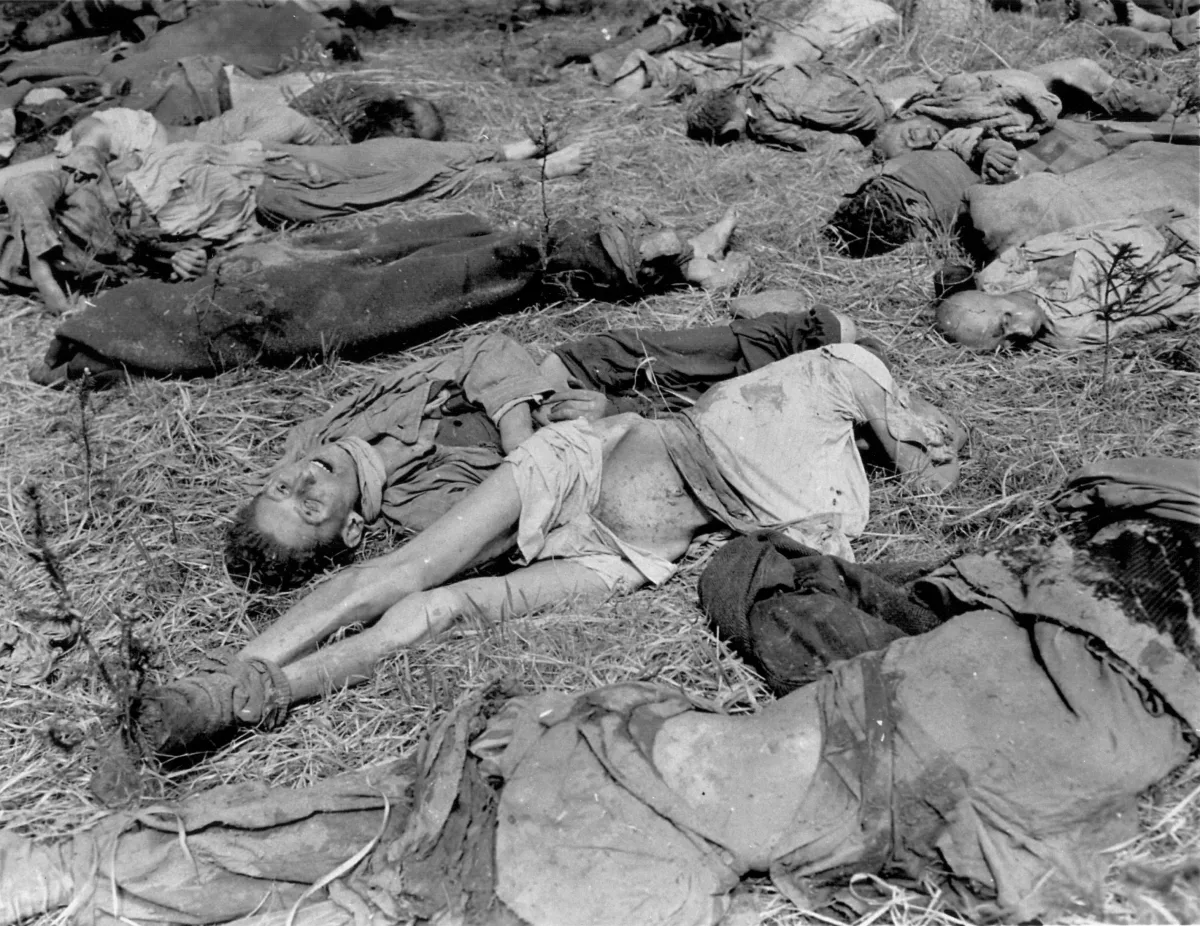
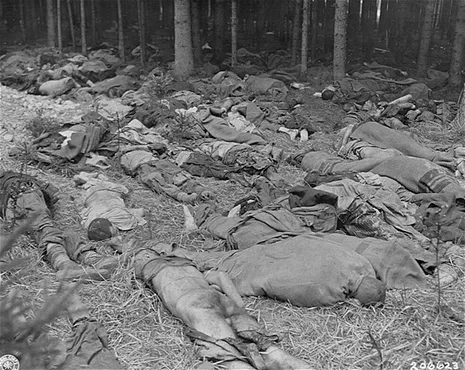
When the American soldiers arrived on 4 May 1945, they found an area of woodland full of dead bodies, sludge and survivors who were completely exhausted. Concentration camp survivor Rabbi Sinai Adler described Gunskirchen as a huge graveyard: “People fought with their last ounces of strength against the clock, the final hours, to escape the cruellest and most deadly tyranny the world has ever seen.” Daniel Chanoch, who survived six concentration camps and was liberated in Gunskirchen, was convinced that “[i]t was the most horrific and devastating concentration camp. It was hell on earth.”
References
“[I was only there] two, three weeks, but Gunskirchen was the worst.”
Jehuda Bacon 1
Gunskirchen satellite camp consisted of two parts: the camp in the former Volksschule (primary school) in the centre of Gunskirchen and the camp in the part of the forest known as the ‘Hochholz’. The prisoners in the forest camp were men, women and children of various ages. There are no prisoner lists available from the satellite camp in the forest, but photographs from the U.S. Army taken during the camp’s liberation show women and small children as well as men.
Almost all of the prisoners in the forest camp of Gunskirchen satellite camp were Jews and they came from a large number of different countries. The largest group were Hungarian Jews who had previously been used as forced labourers in the building of the Südostwall and then deported across Austria to Mauthausen in death marches.2 The American liberators described these prisoners as a diverse group, who were mostly from Budapest: “The inmates of Gunskirchen were a select group of prisoners — the intellectual class of Hungarian Jews, for the most part, professional people, many distinguished doctors, lawyers, representatives of every skilled field.”3
Survivor Jicchak Miglitzer reported that Hungarian wasn’t the only language spoken by prisoners in the camp, but also Slovak, Polish, Serbian, Czech and German. In addition to the large number of Jews, there were also political prisoners from Germany, Austria, the former Czechoslovakia and the former Yugoslavia in the camp.4 These various nationalities are also reflected in the items that have been found at the site of the former satellite camp. During an archaeological survey, a prisoner badge was found with the letters ‘R.E.’, which refers to the Italian air force.5
In the ‘Hochholz’ woodland, the concentration camp prisoners driven from the tent camp at Mauthausen concentration camp to the Gunskirchen satellite camp found a camp that was still unfinished. The majority of the barracks were still being built and most of them were missing a roof, as survivor Dugo Leitner recounted. There were no sanitary facilities. The barracks that were originally designed for 800 people, had to accommodate first 1,500 people, and then later up to 3,000 people. In some cases, the concentration camp prisoners were so tightly packed in that there was hardly any space for them to turn round. Those who were too weak to move simply relieved themselves where they lay.6
Shaul Spielmann – Gunskirchen satellite camp
The survivor Michael Kraus recounted: “Anyone who was sicker than the others was thrown out into the rain where, unable to move, he would die within a few days, or would drown after having been thrown into a puddle.”7
The unbearable stench throughout the area of woodland, both in the barracks and in the roll call area outside, was described by many survivors and also by the American soldiers as particularly intense. The American soldier Captain J. D. Pletcher described the conditions in the barracks: “A pair of feet, black in death, protruded from underneath a tattered blanket just six inches from a haggard old Jew who was resting on his elbow and feebly attempting to wave to us. A little girl, doubled with the gnawing pains of starvation, cried pitifully for help. A dead man rotted beside her.”8
“The stench of death hung in the air.”
Daniel Chanoch 9
The sanitary conditions in the overcrowded camp were terrible. The concentration camp prisoners suffered from lice, which spread rapidly in the overcrowded barracks.10 Illnesses such as epidemic typhus and diarrhoea, mistreatment by the SS and spoiled food were responsible for the deaths of 200 to 300 prisoners every day.11 This is consistent with the majority of statements by survivors that were documented in the first few months after the end of the Nazi regime. Survivor Jicchak Miglitzer reported: “The bodies, which ran to fifty or sixty a day – though there were days with twice that number – were buried in a huge grave […].”12 Assuming there were around 20 days from 16 April until the liberation on 4/5 May 1945 and using Kranebitter’s estimate of 3382 dead13, then that means 169 prisoners died every day. The highest estimate of deaths is 500014, so an average of 250 deaths per day. This estimate is also confirmed by investigations after the end of the Nazi regime but probably also included those victims who died in hospital after the liberation.15 16
Daniel Chanoch – Gunskirchen satellite camp – Hell
George Heller – Gunskirchen satellite camp
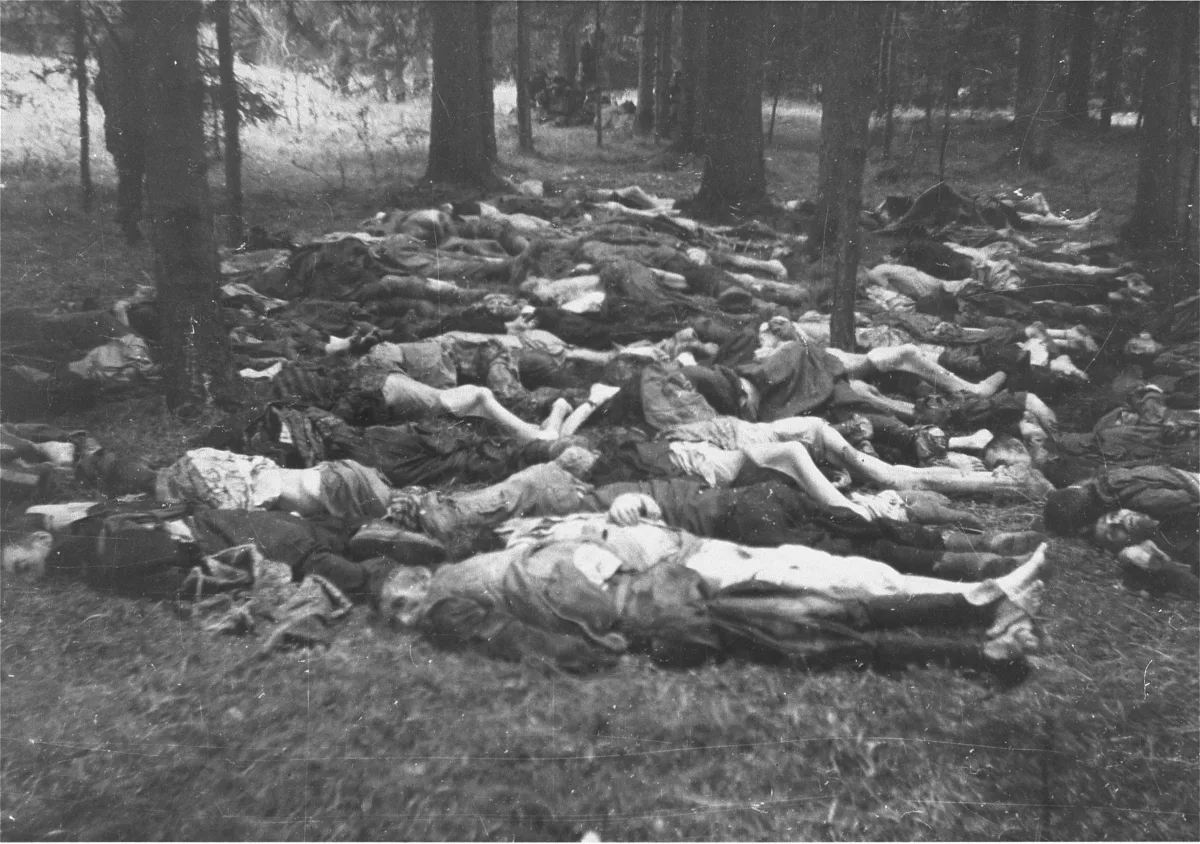
Some of the dead were buried in mass graves, but they were frequently also left lying on the forest floor. Often the prisoners had no other choice but to sleep on top of the dead bodies that lay in the barracks or sit in between them, as they simply didn’t have the strength to carry them outside.17
Irving Balsam – The hell in the forest
Shaul Spielmann – Conditions in the Camp
Yehuda Gurvich – Gunskirchen satellite camp – A place of death
There were only two latrines available for the prisoners to relieve themselves. If they wanted to use them, they had to queue up in long lines. Anyone who couldn’t manage the long wait and collapsed on the ground or relieved themselves where they stood was shot by the SS guards.
The persistent rain in the last few days of April and the first few days of May 1945 made the ground so soft that it became one huge muddy field. As the survivor Shaul Spielmann reported, you could hardly walk on it. Michael Kraus also described the camp’s roll call area as a “landscape of puddles”.18 According to survivor Shaul Spielmann, most people tried to walk on top of the bodies lying on the ground so as not to sink into the mud.
Helen Balsam – The hell in the forest
Edith Eger even reported cases of cannibalism among the prisoners: “Here in hell, I watch a man eat human flesh. Could I do it? For the sake of my own life, could I put my mouth around the skin left hanging on a dead person’s bones and chew? I have seen flesh defiled in unforgivable cruelty. […] But it’s watching a starving person eat a dead person’s flesh that makes the bile rise in me, that makes my vision black.”19
Nicholas Halmay – Gunskirchen satellite camp – Cannibalism
“The food provided was a sweet soup – poison. There also began to be instances of cannibalism.”
Daniel Chanoch 20
The survivor Bernard Freilich also reported: “I have never seen cannibalism before. But there I saw where an SS man tried to shoot one of the Hungarian prisoners, a Hungarian Jew that was so starved, that there was a dead body laying and he ran over, and, knives we were not allowed to have, but everybody had a spoon. And usually the spoon, the edge of the spoon, we were sharpening on a stone to be able to carve a piece of bread or so on. So with that he tried to slice off a piece of flesh from a dead body that starved to hunger.”21
“This place was the beginning of the end of the concentration camps.”
Daniel Chanoch 22
Unlike the majority of other camps, the Gunskirchen satellite camp was neither a labour camp nor a death camp. The concentration camp survivor Edith Eger reported: “There are no gas chambers here, no crematoria. But there is no doubt that we have been sent here to die.”23
There was little semblance of a daily routine. Aside from burying the countless bodies, the prisoners didn’t have to carry out any forced labour. Unlike the camp in the school, where the prisoners were used to carry out lumbering work, the people in the forest camp were more or less left to their own devices. No documents relating to the daily routine remain, but it has been possible to get a picture of this from survivors’ accounts.
Survivor Pal Bacs described the daily routine in the forest camp as follows: The prisoners were woken at 6 a.m. At 6.30 a.m. all prisoners had to attend the morning roll call, where they were counted, regardless of their physical condition. Pal Bacs emphasised the role of ‘Burkus’, who was probably acting as a Kapo (prisoner functionary) and helped the SS with lining up the prisoners and meting out punishments. Then the prisoners were given bitter black coffee. They had nothing to do until 4 p.m. They lay in the barracks, staggered through the camp or joined the interminable queues for the latrines.24
Nicholas Halmay – Gunskirchen satellite camp – Everyday life
“The Americans called Gunskirchen ‘a corner of hell’. […] People ate human flesh. The commandant poisoned soup to kill as many people as possible. This camp was the worst of all of them.”
Daniel Chanoch 25
At midday, the prisoners were given small pieces of bread or crumbs. The bread was distributed to each of the barracks at a time – a procedure that took three to four hours. Each week, the prisoners received 1.4 kg bread and 10–20 g margarine. Food was fiercely fought over among the prisoners and often stolen. In the afternoon, the prisoners were given around 400 ml of beet soup, which mainly consisted of water.26 Once a week the prisoners were given a canned black pudding, which had to be divided between 20 people.27 Water was also scarce and, on the odd occasions that it was provided, the prisoners had to queue up for hours to get some. Often the prisoners drank the rainwater that ran off the roofs of the barracks. Shaul Spielmann reported that he became infected with a particularly severe form of typhoid fever from drinking this water. After the evening roll call, the prisoners finally lay down to sleep.
It was almost impossible for the prisoners to collect and bury the dead due to their extremely weakened state; often it took four people to carry a body.28 István Erdős, a former prisoner of the camp recounts: “The corpses were piled up in heaps next to the latrine. Later, we dug pits with space for 40 bodies and buried them in them, of course without keeping any kind of record.”
Survivor Tabor Wiener described how the dead were collected in the south of the camp and then buried in the eastern part.29
Yehuda Gurvich – Gunskirchen satellite camp – Burying the dead
Survivor Alexander Lowy recalled the abuse of the SS guards: “The guards forced us to place 160 litre petrol drums, which had been cut in half and fitted with handles, in each of the barracks as urinals. They were full by morning. At daybreak, they opened the doors and a couple of officers came in and had us line up. They chose two or three boys at random and dunked them headfirst in the urine. We were forced to watch. They repeated the process with each of the boys in turn. They only let go of a boy when his legs stopped moving – and that could take an eternity. While we were watching one of the boys struggle, the next one in line saw what would happen to him. He was rather small and I saw him slip out of the line before he could be chosen. The Nazis found it entertaining to drown boys in urine and laughed like mad while they were doing it. They opened the doors, drowned the boys they had chosen and ordered those of us who remained to empty the urinals outside.”30
Edith Eger, who was 16 years old at the time of her imprisonment at Gunskirchen, also described the violent excesses of the SS. She wrote of “a boy tied to a tree while the SS officers shot his foot, his hand, his arms, an ear—an innocent child used as target practice. Or the pregnant woman who somehow made it to Auschwitz without being killed outright. When she went into labor, the SS tied her legs together. I’ve never seen agony like hers.”31
Several survivors described a delivery of aid from the Red Cross, which probably arrived in the last few days before the camp was liberated.32 Michael Kraus wrote in his memoirs that food parcels were meant to be handed out to children up to the age of 15.33 Therese Müller described a Red Cross bus that arrived in the camp and was laden with food: “A table is erected and we form up in lines to collect something to eat. I’m given a whole kilo pack of sugar! It has to be eaten very slowly. I will try to eke it out so it lasts a long time. […] The food came too late for many for us. They are now beyond help. The Red Cross bus leaves the camp. We are caged in once again.”34
Edith Eger also described the visit by the Red Cross: “The Red Cross, in its neutrality, has been allowed to deliver aid to prisoners, and Magda has huddled in a line and been handed a can of sardines. But there’s no way to open it. It’s just a new flavor of cruelty. Even a good intention, a good deed, becomes futility.”35
In the final days before the liberation, the supplies collapsed completely. According to survivors’ statements, in the end the prisoners went five days without any food or water.36
On 3 May, the SS guards finally left the camp too; the prisoners were completely abandoned.37 Dugo Leitner reported that they ate bark from the trees, Edith Eger described how she ate the few blades of grass still remaining in the woodland.38
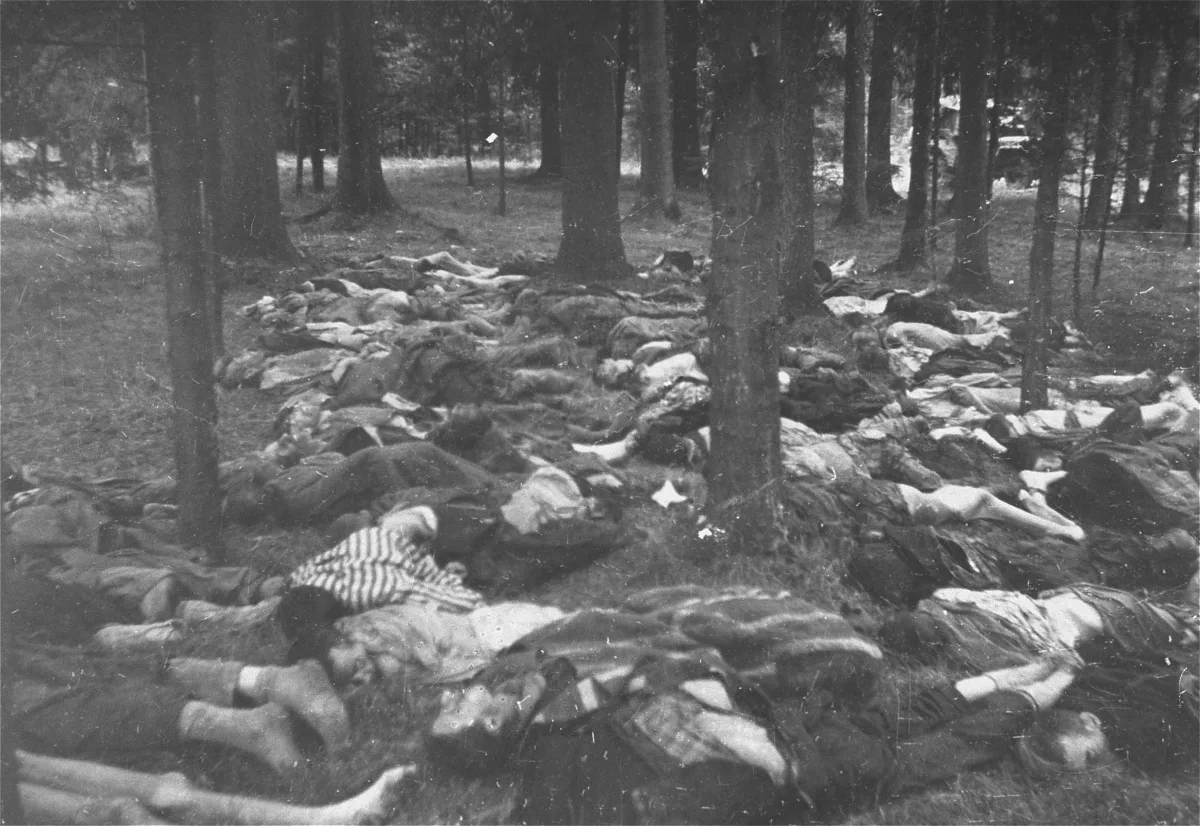
When the American soldiers arrived on 4 May 1945, they found an area of woodland full of dead bodies, sludge and survivors who were completely exhausted. Concentration camp survivor Rabbi Sinai Adler described Gunskirchen as a huge graveyard: “People fought with their last ounces of strength against the clock, the final hours, to escape the cruellest and most deadly tyranny the world has ever seen.” Daniel Chanoch, who survived six concentration camps and was liberated in Gunskirchen, was convinced that: “It was the most horrific and devastating concentration camp. It was hell on earth.”
References
Yehuda Gurvich – Speech at the U.S. Army memorial stone during the “Walk of Solidarity” as part of the liberation ceremony
Source: Interview Jehuda Gurvich
Michael Kraus – The hell in the forest
Source: Interview Michael Kraus
Shaul Spielmann – Speech at the U.S. Army memorial stone during the “Walk of Solidarity” as part of the liberation ceremony
Source: Interview Shaul Spielmann
Explore individual locations in three dimensions.
Opening this view loads external content.
Open view in a new tabcontinue to